Online Reaction Test No Time Limit
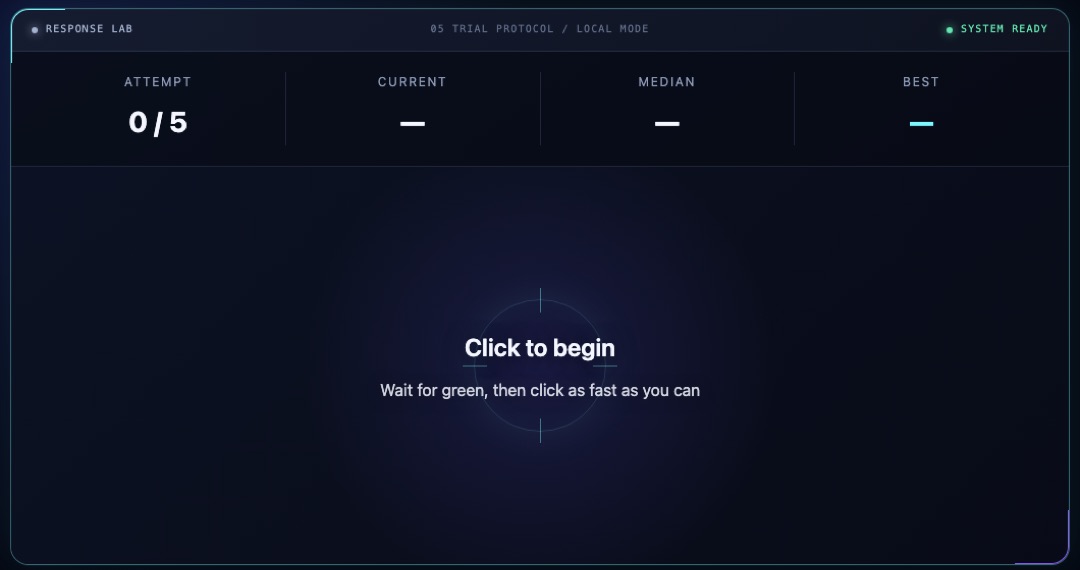
Search for an online reaction test with no time limit and what you usually want is simple: a reflex measurement without a countdown clock breathing down your neck. Here is the good news — that is exactly how a well-built reaction test already works. On our [five-round reaction test](/), nothing ticks down while you play. The only clock that matters runs silently between the signal appearing and your click landing, and you never see it until the round is over.
Overview
Search for an online reaction test with no time limit and what you usually want is simple: a reflex measurement without a countdown clock breathing down your neck. Here is the good news — that is exactly how a well-built reaction test already works. On our five-round reaction test, nothing ticks down while you play. The only clock that matters runs silently between the signal appearing and your click landing, and you never see it until the round is over.
That design is deliberate, not a missing feature. This guide explains why serious reaction tests skip time limits entirely, what pressure and rushing actually do to your attention, and how to switch between a relaxed session and a competitive one depending on what you want to learn about yourself.
Why a Good Reaction Test Has No Countdown
Reaction time is the gap between a stimulus and your response. To measure it cleanly, exactly one thing must stay unknown: the moment the signal appears. A countdown hands you that answer in advance. Watch the numbers fall to zero and you are no longer reacting — you are timing, which is a different skill with a different result.
The standard protocol solves this by replacing the countdown with a random waiting period. The screen changes after an unpredictable delay, so every round forces a genuine response instead of a well-timed guess. You can read how the timer, the random delay, and the hardware limits work on our methodology page.
The no-time-limit idea matters in the other direction too. Nobody is rushing you to finish the session. You can settle into your chair, breathe, and start each round when you feel ready. The only interval being measured is the fraction of a second the test actually cares about — everything around it can take as long as you like.
What Pressure and Rushing Do to Your Attention
Time pressure quietly changes the task. Under a visible countdown, attention tilts away from the stimulus and toward the clock itself. Part of your mind starts monitoring time instead of waiting for the signal, and the number you produce reflects that split focus rather than your reflexes.
Push the urgency hard enough and the classic failure shows up: anticipation. You click before the signal appears, or your reaction looks impossibly fast because you predicted it. On any browser test, a score under roughly 100 ms is not a genuine reaction — a 60 Hz display alone redraws every 16.7 milliseconds, and your nervous system needs far longer than that to see the change and respond. Sub-100 ms results mean guessing, not speed.
There is a slower cost as well. Rushing makes attention brittle across a whole session: after a dozen back-to-back rounds, most people find their focus drifting and their results scattering in both directions. Fatigue compounds the effect. In a well-known sleep study, cumulative sleep restriction degraded sustained attention and cognitive performance dose-dependently across days — the less rest, the steeper the decline (Van Dongen et al., 2003). Test late at night while pushing for a number and you are measuring exhaustion as much as reflexes.
Skip the guesswork — measure it
Reading about reaction time only gets you so far. The five-round test takes about a minute and gives you a median score you can actually track.
Take the reaction time testRelaxed Practice vs Competitive Sessions
Two mindsets are worth separating, because they answer different questions. A relaxed session asks: what is my honest baseline right now? You treat each round as independent, let the result be whatever it is, and accept a slightly slower but truthful number. A competitive session asks: how fast can I push myself today? That question is legitimate — but its answers are not comparable with your calm baseline, and mixing the two muddies both.
Running this site, we notice that the people who improve most steadily are usually the ones who keep these sessions apart. A relaxed round looks like this:
- No target score in your head before you start.
- Full attention on waiting for the signal, not on the last result.
- A handful of calm rounds, then stopping while focus is still fresh.
- The same device, browser, and setting every time.
- Treating the occasional slow round as information, not failure.
The competitive mindset has its place too — motivation, variety, and rehearsing pressure itself. And speed is not the enemy of composure. Trained action video game players respond faster than non-players without sacrificing accuracy, which suggests quickness is a skill built through calm repetition rather than strain (Dye, Green & Bavelier, 2009). The strain version of fast — jittery, anticipatory, error-prone — is what pressure-free practice trains out of you.
Matching the Mode to the Mindset
Different test formats suit different headspaces, and picking the right one keeps your sessions honest. For an untimed baseline, the standard five-round test is the calmest option: short, unhurried, and over before fatigue sets in. If you want a longer relaxed session with more data per sitting, the ten-round reaction speed test extends the same no-countdown format.
Two modes add deliberate load on top. The choice-color reflex test asks you to respond only to the correct color, layering a decision onto the reaction — closer to real-world situations where the right response matters as much as a fast one. The F1 lights-out test is the pressure rehearsal: five lights extinguish after a random hold, and jumping early is punished with a false start. It is the closest thing to a countdown worth taking seriously, precisely because guessing is penalized rather than rewarded.
How to Run a Pressure-Free Session
A calm session is mostly about removing small sources of urgency before they reach your attention:
- Close notifications, chat windows, and background video before the first round.
- Sit comfortably with your hand resting on the mouse or screen, not hovering tense above it.
- Breathe out slowly as each round begins, and simply wait.
- If you false-start, shrug and restart — one anticipated click says nothing about you.
- Stop after a handful of rounds, while waiting still feels easy.
Whatever number you land on, treat it as rough orientation rather than a verdict. An online score always includes your device and display latency, so it is a reference estimate for tracking your own trend — never a diagnosis, and never directly comparable with laboratory figures. In calibrated lab conditions, mean simple visual reaction time across 1,469 adults was about 231 ms (Woods et al., 2015), while a web-based sample of 10,060 participants — the setup closest to yours — reported a median of 301 ms. Different protocols, different scales, all honest within themselves.
FAQ
Is a reaction test with no time limit less accurate?
Quite the opposite. The random, unannounced delay is what makes the measurement honest, because it removes prediction from the result. A countdown would tell you when to click; an untimed wait forces your nervous system to do the work. That is the same basic logic used in laboratory protocols.
Why do I click early when I try to go faster?
Trying to be fast shifts you from reacting to predicting. Your brain starts betting on when the signal will appear, and sometimes it bets early. Since genuine reactions on a browser test cannot realistically fall below about 100 ms, early clicks and suspiciously tiny numbers are both signs that anticipation has replaced attention.
Should I practice relaxed or under pressure?
Build your baseline relaxed, then add pressure occasionally and on purpose. Calm sessions teach clean waiting and consistent responses; competitive sessions teach you to hold that composure when stakes appear. Research on action game players suggests speed and accuracy can grow together, so you do not need stress to get fast.
Can an untimed test prepare me for real pressure situations?
Partially. Untimed practice builds the floor — a stable, anticipation-free response you can trust. For the pressure side, use a mode designed for it, like the F1 lights-out format, where a random hold and false-start penalty simulate the real tension of waiting for a start signal.
How long should one session last?
A few minutes is enough. Five calm rounds give you a usable snapshot; beyond a dozen or so back-to-back rounds, attention tends to drift and the extra data adds noise rather than insight. Stop while waiting still feels effortless.
Sources
- Woods et al. (2015), Frontiers in Human Neuroscience — calibrated lab simple visual RT, 1,469 adults.
- Web-based reaction time sample (2020), Frontiers in Aging Neuroscience — median 301 ms in 10,060 online participants.
- Van Dongen et al. (2003), Sleep — sleep restriction degrades sustained attention dose-dependently.
- Dye, Green & Bavelier (2009) — action gamers respond faster without losing accuracy.
- Best Reaction Test methodology — timer, random delay, and hardware limits.

Mikasa writes the timer code, reads the primary research, and checks every published claim against it — the same standard described in our editorial policy.
This article is educational, not medical or safety advice. Claims are reviewed against the linked sources and our editorial policy.
Launch the reaction time test
Five rounds, random delays, median score — run it on this device and start your own baseline today.
Start the five-round test