Online Reaction Test Fun and Challenging
Some games hook you with storylines, graphics, or a leveling system. An online reaction test hooks you with a single number. You wait, the screen flashes, you click — and about a minute later you have a score in milliseconds that you immediately want to beat. We run the free [reaction time test](/) on Best Reaction Test, and the pattern is remarkably consistent: almost nobody stops after one session.
Overview
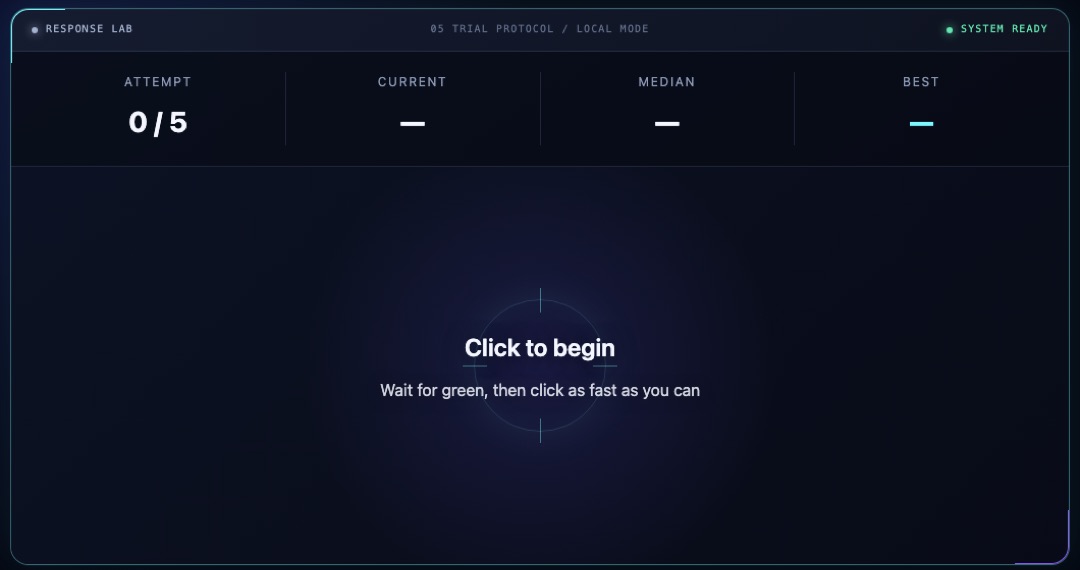
Some games hook you with storylines, graphics, or a leveling system. An online reaction test hooks you with a single number. You wait, the screen flashes, you click — and about a minute later you have a score in milliseconds that you immediately want to beat. We run the free reaction time test on Best Reaction Test, and the pattern is remarkably consistent: almost nobody stops after one session.
This article looks at the fun side of that experience — why such a minimal challenge is so hard to put down, how competing against your own past results keeps it interesting, and how a few small daily sessions can turn a curiosity into a habit. Along the way we will anchor the fun in real numbers, because the game only means something if the score does.
Why a One-Minute Test Is Hard to Put Down
The appeal comes down to a tight feedback loop. The rules take ten seconds to learn, a round takes a few seconds to play, and the result arrives instantly. Very few activities compress effort, outcome, and the urge to retry into such a small package.
The random delay before the signal does a lot of quiet work here. Because you cannot predict when the color will change, every round carries a small charge of suspense. Anticipate and you get flagged for jumping early; hesitate and you watch milliseconds slip away. That tension, repeated five times per session, is the whole game — and it is enough.
There is also something satisfying about how legible the result is. A median of five rounds is a clean, personal fact about you at that moment, and it invites the obvious follow-up: was that my best, or can I do better right now? Most people answer by clicking start again.
Beating Yourself: The Only Leaderboard That Matters
Online reaction scores are not really comparable between people, and that turns out to be a feature. Your score includes your device, your browser, and your display — a 60 Hz screen redraws only every 16.7 milliseconds or so, and input hardware adds its own delay on top. A score on a phone touchscreen never feels identical to a mouse score, because it genuinely is not the same measurement.
So the meaningful competition is against yourself, on your own setup, under similar conditions. Yesterday's median becomes today's target — self-competition in its purest form, against an opponent who knows all your weaknesses because that opponent is you.
Running this site, we notice the same arc over and over. A first round is almost always the slowest, as attention warms up; the next few rounds settle into a personal rhythm; and after a dozen back-to-back rounds, focus starts to drift and scores creep upward again. Watching that arc in your own numbers is oddly absorbing.
Skip the guesswork — measure it
Reading about reaction time only gets you so far. The five-round test takes about a minute and gives you a median score you can actually track.
Take the reaction time testThe Numbers That Give the Game Meaning
A personal best is only fun to chase if you have some sense of the scale. In calibrated laboratory conditions, a 2015 study by Woods and colleagues put mean simple visual reaction time near 231 ms across 1,469 adults. A web-based sample of 10,060 participants — much closer to what you are doing right now — reported a median of 301 ms.
Other large protocols landed in between and beyond: Vincent and colleagues reported 261 ms in more than 107,000 participants, while Deary and Der's computer protocol produced 328 ms in 1,930 adults. The spread itself is the lesson — there is no single universal average human reaction time, only results tied to specific methods. Our average reaction time page walks through these figures in more detail.
A few practical anchors make the game easier to read:
- Under roughly 100 ms in a browser test, you anticipated the signal — that is prediction, not reaction.
- Lab-grade numbers near 231 ms come from calibrated hardware your laptop does not have.
- A median around 300 ms is entirely ordinary for an honest online attempt.
- Age shifts the scale gently: observed means in the Woods data rose from about 218 ms in the youngest adults to roughly 239 ms in the oldest, and Wilkinson and Allison found the same slow decade-by-decade pattern across 5,325 participants.
Treat these as rough orientation, not diagnosis. The fun is in beating your own history, not in matching a laboratory you will never visit.
Small Sessions, Real Habit
The same minimalism that makes a reaction test addictive also makes it easy to keep. One five-round session fits inside a coffee break, and that is exactly the right dose. Long grinding sessions work against you: attention drifts, fatigue accumulates, and the scores stop telling you anything except that you have been staring at a screen too long.
A sustainable routine looks something like this:
- One short session per day beats ten sessions in one sitting, then none for a month.
- Test at a similar time of day so the comparison stays fair.
- Stop while it still feels sharp — the moment rounds blur together, the data stops being useful.
- Record or remember your median, not your single luckiest click.
- Expect slow days; a bad afternoon is usually a bad afternoon, not a new you.
Test late at night and you will likely see the cost of the day in your numbers — that is not imagination. Van Dongen and colleagues showed that cumulative sleep restriction degrades sustained attention and cognitive performance in a dose-dependent way. The flip side is motivational: your scores quietly reward a rested evening.
If the habit takes hold and you want to push further, there is evidence that certain kinds of practice matter. Dye, Green and Bavelier found that action video game players respond faster without sacrificing accuracy — a hint that speeded responding is a trainable skill, not just a fixed trait. Our reaction training guide goes deeper into what practice can and cannot do.
Keeping It Fresh: Three Ways to Remix the Challenge
Even the best one-minute game benefits from variety, and different modes challenge genuinely different skills. Switching keeps attention honest, because each variant breaks the rhythm your brain has memorized.
- The 10-round reaction speed test doubles the session length, testing consistency rather than a single burst of focus.
- The choice reflex test replaces one signal with several colors, so you must decide as well as react — a different and harder skill.
- The F1 lights-out test recreates the start of a Grand Prix, where five red lights hold for a random beat and the start is everything.
Rotating through these keeps the daily session from going stale, and the contrast is instructive. Most people find their choice-mode times noticeably slower than their simple times, because deciding costs milliseconds that pure reacting does not.
FAQ
Why is a reaction test so addictive?
It compresses the core loop of any good game — challenge, instant feedback, immediate chance to retry — into about a minute. The random signal adds suspense, and the millisecond score makes every improvement tangible.
Because the opponent is your own previous median, there is always a reachable next goal. That mix of low friction and endless self-competition keeps people coming back.
Is it bad that I keep retaking the test?
Retaking within a session is normal, but there is a sensible limit. After a dozen or so back-to-back rounds, attention drifts and later scores mostly measure fatigue. One or two focused sessions a day gives you the fun and the useful data; grinding gives you neither.
Why do my scores vary so much between sessions?
Reaction time is state-dependent, not a fixed trait. Sleep, distraction, time of day, and simple warm-up all move the number. Variation between sessions is the rule, which is why trends in your median matter more than any single result.
Is a very fast score, like under 100 ms, real?
On a browser test, almost certainly not — it means the click was timed to a guess rather than to seeing the signal. Device and display latency alone (a 60 Hz screen redraws every ~16.7 ms) make scores that low implausible as genuine reactions. Treat flagged early clicks as misses and move on.
Can reaction testing actually make me faster?
Practice reliably improves consistency and task-specific performance — you learn the rhythm, cut wasted motion, and hold focus better. Evidence that action game players respond faster without losing accuracy suggests speeded responding is partly trainable. Treat claims of dramatic permanent change with caution, and enjoy the modest, real gains in steadiness.
Sources
- Woods et al. (2015), Frontiers in Human Neuroscience — lab mean ≈ 231 ms; Vincent and Deary & Der protocols.
- Web-based sample (2020), Frontiers in Aging Neuroscience — online median 301 ms, N=10,060.
- Van Dongen et al. (2003), Sleep — sleep restriction degrades sustained attention dose-dependently.
- Dye, Green & Bavelier (2009) — action gamers respond faster without losing accuracy.
- Wilkinson & Allison (1989) — age-decade differences across 5,325 participants.

Mikasa writes the timer code, reads the primary research, and checks every published claim against it — the same standard described in our editorial policy.
This article is educational, not medical or safety advice. Claims are reviewed against the linked sources and our editorial policy.
Launch the reaction time test
Five rounds, random delays, median score — run it on this device and start your own baseline today.
Start the five-round test