Measure Your Reaction Time Online Test
Taking a reaction time test online is easy. Measuring your reaction time well — in a way that tells you something true about yourself — takes a little more discipline. The difference between a number you can trust and a number that misleads you usually comes down to protocol: how many rounds you run, which result you record, and how consistently you set up each session.
Overview
Taking a reaction time test online is easy. Measuring your reaction time well — in a way that tells you something true about yourself — takes a little more discipline. The difference between a number you can trust and a number that misleads you usually comes down to protocol: how many rounds you run, which result you record, and how consistently you set up each session.
This guide is about that discipline. It covers why one fast click is a weak measurement, why the median of several rounds is better, how to run comparable sessions week to week, and which mistakes quietly corrupt your data. You can follow along with the free five-round reaction time test on this site, and find the technical details of our timer and hardware limits on the methodology page.
Why a Single Score Misleads
Reaction time is not a fixed trait like your height. It is a performance that varies from moment to moment — with attention, alertness, familiarity with the task, and plain random noise. One round samples that moving target once, and one sample says almost nothing about your typical level.
The published research makes the scale problem obvious. In a calibrated laboratory setup, Woods and colleagues (2015) measured simple visual reaction time in 1,469 adults and reported a mean of about 231 ms. A large computerized study by Vincent and colleagues, with 107,413 participants, reported 261 ms. A different computer protocol used by Deary and Der produced 328 ms in 1,930 adults. And a web-based sample of 10,060 participants — the setup closest to your browser — reported a median of 301 ms and a mean of about 318 ms.
Same human reflex, four different 'averages' — every protocol defines its own scale. Your browser score includes your device and your session conditions, so treat any single number as a reading on one instrument, not as a universal measure of you.
Median vs. Best Round
When you run several rounds, two summary numbers compete for your attention: your best round and your median. They measure different things. Your best round is a lucky alignment of alertness, timing, and sometimes a hint of anticipation. Your median is the round that sits in the middle — half your rounds were faster, half were slower.
For tracking yourself, the median wins almost every time:
- It resists outliers, so one lucky click cannot inflate your result.
- It also resists disasters — one distracted round does not sink it.
- It tracks your typical performance, which is what changes slowly over weeks.
- It stays comparable between sessions even when one session has an odd round.
The best round is fine as entertainment. But recording only personal bests charts your luckiest moments, and 'progress' becomes noise — which is why our test reports the median of five rounds.
Why Five Rounds, Not One or Fifty
Five rounds is a practical compromise. One round is a coin flip against random variation. Dozens of rounds in a row introduce a different problem: fatigue and boredom drift your times upward, until later rounds measure tiredness more than reflexes.
With five rounds, the median is the third-fastest result — a real round you actually produced, not an average of numbers you never scored. It takes about a minute, short enough that focus stays sharp from start to finish. For a clean baseline reading, keep the session short.
Skip the guesswork — measure it
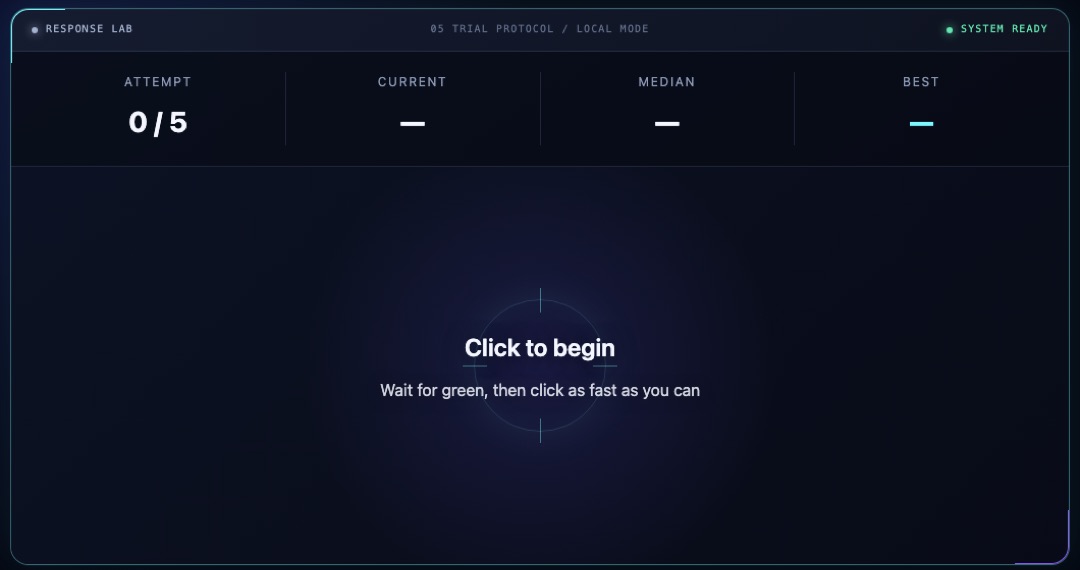
Reading about reaction time only gets you so far. The five-round test takes about a minute and gives you a median score you can actually track.
Take the reaction time testRead the Spread, Not Just the Middle
A session gives you more information than its median. Look at how tightly the five rounds cluster. A median of 270 ms with rounds between 255 and 285 ms is a stable, trustworthy session. The same median with rounds scattered from 230 to 420 ms says your attention wandered, and the median itself is shakier ground.
Tightening spread over time is itself a meaningful signal: practice tends to make performance more consistent before it makes it faster. Running this site, we see people fixate on shaving a few milliseconds off their median while their spread has halved — the tighter spread is often the bigger improvement. Results vary, so treat both numbers as rough orientation, not diagnosis.
A Session Protocol That Actually Works
Good measurement is boring measurement. The goal is to hold everything constant except the thing you want to observe — your reaction time on an ordinary day. A workable protocol:
- Same device, same browser, same input (mouse or touchscreen) every session.
- Same rough time of day, so daily alertness rhythms do not confuse the comparison.
- A quiet room with notifications off and no background video or music.
- A comfortable seated posture, with your responding hand resting in the same position.
- Five rounds per session, then stop — do not grind extra rounds chasing a better number.
- Record the median and the date in a note or spreadsheet before you close the tab.
A 60 Hz display redraws only every 16.7 ms or so, and your mouse, operating system, and browser each add their own small delays. None of this is a flaw — but it means your score is partly your hardware. Keeping hardware constant is what makes scores comparable across sessions — the only comparison that matters. Details are on our methodology page.
Tracking Over Weeks, Not Minutes
One session tells you about one moment. A log of sessions tells you about you. Test two or three times a week under your standard protocol, write down each median, and watch the trend over four to six weeks. That wobbling trend line is your actual baseline.
Expect the day-to-day numbers to wobble. Sleep alone can move performance substantially: Van Dongen and colleagues (2003) showed that cumulative sleep restriction degrades sustained attention and cognitive performance dose-dependently. A bad median after a short night is information about your week, not a verdict on your reflexes. Age shifts things too, but gently — in the Woods et al. data, observed means rose gradually from about 218 ms in the youngest adult group to roughly 239 ms in the oldest, and Wilkinson and Allison (1989) found a similar decade-by-decade pattern across 5,325 participants. Our average reaction time page compares these study figures.
Common Measurement Errors
Most misleading scores trace back to a short list of avoidable errors:
- Anticipation — clicking on a predicted rhythm rather than the signal itself. The random delay exists to defeat this; if you 'guess right', that round is not a reaction.
- Fatigue drift — running round after round until your times slide upward, then recording the tired numbers.
- Device switching — comparing a phone score to a laptop score as if they were the same instrument.
- Context noise — testing mid-conversation, with a video playing, or with notifications popping.
- Selective recording — writing down only the good sessions, which flatters the trend and hides real variation.
- Retesting immediately after a bad round — the second session measures your frustration as much as your reflexes.
None of these require equipment to fix. They require a routine you actually keep.
FAQ
Is my best round my real reaction time?
Probably not. A single best round captures a lucky moment — high alertness, good timing, sometimes mild anticipation. Your median across rounds is a far more stable estimate of your typical performance, which is why our test reports it.
How many rounds should I run per session?
Five is a good default: enough for a meaningful median, few enough that fatigue does not distort the later rounds. Consistency across sessions matters more than round count within one session.
Why is my online score slower than the lab averages I read about?
Because your device is part of the measurement. A 60 Hz screen alone quantizes the signal into ~16.7 ms frames, and input hardware adds more. Lab studies with calibrated equipment report means around 231 ms; a large web-based sample reported a median of 301 ms. Neither scale is 'wrong' — they are different instruments.
How often should I retest?
Two or three sessions per week, under the same conditions, is plenty. Back-to-back retests mostly measure fatigue and mood; log the median and move on.
Can I compare my score with my friend's?
Only loosely. Unless you both tested on the same device in the same setup, hardware differences are baked into both numbers. A fairer approach: compare each of you against your own trend over weeks.
Sources
- Woods et al. (2015), Frontiers in Human Neuroscience — calibrated lab mean ≈ 231 ms; also summarizes the Vincent et al. and Deary & Der protocols.
- Web-based reaction time sample (2020), Frontiers in Aging Neuroscience — median 301 ms across 10,060 online participants.
- Wilkinson & Allison (1989) — age-decade reaction time differences in 5,325 participants.
- Van Dongen et al. (2003), Sleep — sleep restriction degrades attention and cognitive performance.
- Best Reaction Test methodology — timer, five-round median, and hardware limits.

Mikasa writes the timer code, reads the primary research, and checks every published claim against it — the same standard described in our editorial policy.
This article is educational, not medical or safety advice. Claims are reviewed against the linked sources and our editorial policy.
Launch the reaction time test
Five rounds, random delays, median score — run it on this device and start your own baseline today.
Start the five-round test