Improve Your Reaction Time Tips and Tricks
Improving your reaction time is less about raw talent and more about removing the things that quietly slow you down. Sleep debt, a distracting room, an inconsistent setup, and sloppy measuring habits can each add precious milliseconds to your score — and most of them are fixable with ordinary effort.
Overview
Improving your reaction time is less about raw talent and more about removing the things that quietly slow you down. Sleep debt, a distracting room, an inconsistent setup, and sloppy measuring habits can each add precious milliseconds to your score — and most of them are fixable with ordinary effort.
One caveat before the tips: an online score is never pure biology. A standard 60 Hz screen redraws every 16.7 milliseconds, so your display and input hardware are baked into every number you see. The goal, then, is not to chase a single universal benchmark but to make your own results faster and more consistent under fair, repeatable conditions. You can check your current level anytime with our five-round reaction time test.
Fix Your Sleep First
If you only change one thing, change this. In a landmark 2003 study, Van Dongen and colleagues restricted volunteers' sleep over multiple nights and found that sustained attention and cognitive performance degraded in a dose-dependent way — the less sleep people got, and the more days the restriction continued, the worse they performed. Reaction tasks are exactly the kind of sustained-attention work that suffers most.
The practical takeaway is simple: don't measure or train your reaction time on short sleep and expect your best. A well-rested evening session will usually beat a bleary late-night one by a clear margin, and no amount of focus compensates for accumulated sleep debt. Treat sleep as part of the training program, not as an obstacle to it.
Set Up a Clean, Consistent Test Environment
Your surroundings and your hardware shape your score as much as your nervous system does. A notification popping up mid-round, a video playing in another tab, or a housemate talking nearby all cost you attention — and attention is the currency reaction time is paid in.
Consistency matters just as much as quiet. Because device latency is part of every online result, switching between a phone, a laptop trackpad, and a desktop mouse makes your numbers impossible to compare. Pick one device and one input method, and keep them. Our methodology page explains in detail how the timer works and where hardware limits come from.
- Silence notifications and close unrelated tabs before you start.
- Test in the same spot, on the same device, with the same input every session.
- Sit at a comfortable distance with your hand already resting on the mouse or screen.
- Test at a similar time of day so fatigue and daily rhythm don't skew comparisons.
- Use a stable connection and avoid testing while big downloads run in the background.
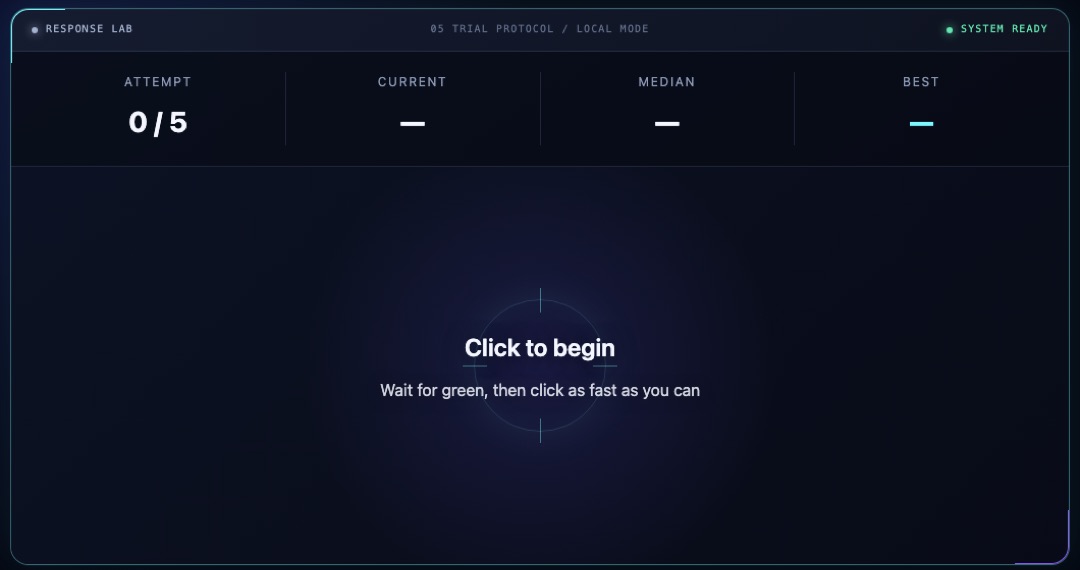
Skip the guesswork — measure it
Reading about reaction time only gets you so far. The five-round test takes about a minute and gives you a median score you can actually track.
Take the reaction time testWarm Up, Then Pace Yourself
Your first round of the day is rarely your truest. Part of it is spent re-learning the task — what the signal looks like, how the timing feels — so later rounds usually reflect your actual speed better. Run one or two throwaway rounds to settle in before you start a session you plan to record.
The opposite trap is grinding through dozens of rounds back to back. Mental fatigue builds quietly, and your times drift upward without you noticing — which is exactly why our main test stops at five rounds and reports the median. If you want more volume, take a real break between short sessions rather than pushing through one long one. A few focused rounds done well beat fifty sloppy ones.
Don't Anticipate — and Track the Right Number
Once you know roughly when the signal tends to appear, there's a strong temptation to click on prediction rather than perception. That produces impressive numbers that measure nothing — anticipation is not reaction. Our test uses a random delay precisely to defeat this; if you find yourself guessing, consciously wait for the color change and accept the slower, honest score.
Just as important: stop tracking your personal best. One lucky round tells you almost nothing about your actual reflexes. The median of a full session is far more stable and far more honest, and the trend of your medians over weeks is what shows real improvement. If you're unsure how to read your numbers, our guide to what counts as a good reaction time walks through score interpretation.
- Record the session median, never a single best round.
- Log the date, device, and rough conditions with each session.
- Compare medians across weeks, not individual sessions across hours.
- Discard sessions where you know you were distracted or exhausted.
- Treat improvements of a few milliseconds as meaningful — that is how progress actually looks.
Practice Deliberately — Yes, Games Count
Reaction speed responds to practice, and some practice is more fun than others. Dye, Green, and Bavelier (2009) found that action video game players respond faster than non-players across a range of tasks — and crucially, without sacrificing accuracy. Fast-paced games demand exactly the skills a reaction test measures: sustained attention, quick stimulus detection, and immediate motor response.
That doesn't mean any game at any dose is a training program; treat it as encouraging evidence, not a prescription, since results vary from person to person. For more focused work, structured drills beat unstructured play. Our reaction training guide lays out a progressive routine built around the same test you already use, and the choice-based reflex test adds a harder variation once simple reactions feel easy.
FAQ
How much can I realistically improve my reaction time?
Most improvement comes from consistency rather than a lower biological floor: fewer distracted rounds, less day-to-day scatter, and a median that drifts down modestly as you get comfortable with the task. Dramatic overnight transformations are not a realistic expectation — think weeks of small, steady gains.
Also keep the measurement honest. If you improve your sleep, setup, and focus at the same time, part of the gain is simply a fairer measurement of the reflexes you already had.
Why do my scores vary so much from day to day?
Because you're not a constant. Sleep quality, fatigue, attention, time of day, and even where your hand rests all shift your score by noticeable amounts. The Van Dongen sleep research alone shows how sharply sustained attention moves with rest.
This variability is exactly why single scores are misleading. Control what you can — same device, same conditions, similar time of day — and judge yourself on the trend of your medians, not on any individual result.
Does reaction time get slower with age?
Yes, but gradually — it's a gentle slope, not a cliff. In the Woods et al. (2015) data on 1,469 adults, observed mean simple visual reaction time rose from roughly 218 ms in the youngest adult group to about 239 ms in the oldest. Wilkinson and Allison found a similar decade-by-decade pattern across 5,325 participants.
Those are laboratory reference estimates, and browser-based scores run higher because they include device latency. Either way, age-related change is measured in a few milliseconds per decade — sleep and attention move your score far more.
Do video games really make you faster?
The best available evidence says action games help. Dye, Green, and Bavelier (2009) showed that action game players respond faster without trading away accuracy, across several different tasks. That suggests a genuine improvement in processing speed, not just recklessness.
One study isn't a guarantee, and the effect was strongest for fast-paced action titles specifically. Consider gaming a legitimate supplement to structured practice, not a replacement for it.
What's the fastest way to see progress?
Fix sleep, kill distractions, and standardize your setup first — those changes show up in your numbers within days because they remove noise rather than rebuild ability. Then add regular short sessions: a few focused rounds several times a week, tracking medians.
Running this site, we see the same pattern repeatedly: people who test consistently under stable conditions improve steadily, while people who binge-test in irregular bursts mostly see noise. Slow, structured practice wins.
Sources
- Woods et al. (2015), Frontiers in Human Neuroscience — calibrated simple visual reaction time and age trends in 1,469 adults.
- Van Dongen et al. (2003), Sleep — cumulative sleep restriction degrades sustained attention dose-dependently.
- Dye, Green & Bavelier (2009) — action video game players respond faster without losing accuracy.
- Wilkinson & Allison (1989) — decade-by-decade reaction time differences in 5,325 participants.
- Web-based reaction time sample (2020), Frontiers in Aging Neuroscience — median 301 ms across 10,060 online participants.

Mikasa writes the timer code, reads the primary research, and checks every published claim against it — the same standard described in our editorial policy.
This article is educational, not medical or safety advice. Claims are reviewed against the linked sources and our editorial policy.
Launch the reaction time test
Five rounds, random delays, median score — run it on this device and start your own baseline today.
Start the five-round test