Improve Your Reaction Time Online Training
Can you actually train your reaction time, or is it fixed at birth? The honest answer sits in the middle. Practice reliably makes you faster and more consistent at the specific task you practice, while dramatic claims about permanently rewiring your nervous system are much harder to support. This guide separates what the evidence backs from what sounds good in marketing, and gives you a concrete weekly routine built around our five-round test.
Overview
Can you actually train your reaction time, or is it fixed at birth? The honest answer sits in the middle. Practice reliably makes you faster and more consistent at the specific task you practice, while dramatic claims about permanently rewiring your nervous system are much harder to support. This guide separates what the evidence backs from what sounds good in marketing, and gives you a concrete weekly routine built around our five-round test.
One principle frames everything below: improvement you can measure is improvement within a task, under repeatable conditions. Your browser score includes your device and your state on the day, so the right goal is not chasing a universal number — it is moving your own median on the same setup, session after session.
What Training Can and Cannot Change
Start with what reaction time is. In a simple visual task, your retina detects a change, your visual cortex processes it, your brain issues a motor command, and your finger responds. Laboratory work gives us calibrated reference points: a 2015 study by Woods and colleagues put the mean simple visual reaction time at about 231 ms across 1,469 adults.
That baseline is real, but it is not a ceiling or a floor for you personally. The same review summarizes a computerized study by Vincent and colleagues reporting 261 ms in over 107,000 participants, and a different protocol by Deary and Der producing 328 ms in 1,930 adults — proof that the number depends heavily on how it is measured. A web-based sample of 10,060 participants, the setup closest to online testing, reported a median of 301 ms.
Where does that leave training? Practice clearly improves consistency: fewer lapses, fewer wasted movements, tighter spread between your best and worst rounds. It also improves task-specific speed, because part of any early score is spent learning what the signal looks like. What it probably does not do is rebuild your underlying physiology in a few weeks. Treat any program promising that with skepticism, and treat the ranges above as rough orientation, not diagnosis.
Sleep: The Single Biggest Lever
If you want one change with solid evidence behind it, fix your sleep. The landmark Van Dongen et al. (2003) study restricted participants' sleep over consecutive days and found that sustained attention and cognitive performance degraded in a dose-dependent way — the less sleep, the worse the decline, and it accumulated rather than plateauing.
Sustained attention is exactly what a reaction test demands: you must stay locked on the screen through a random delay and respond the instant the signal arrives. A tired brain does not just respond slower on average — it produces more lapses, the occasional round where your attention drifts entirely. Running this site, we see the same pattern: people test late at night, get a mediocre median, and assume that is their level.
The practical takeaway is boring but powerful. Test and train at a time of day when you are genuinely alert, and protect your sleep in the days before you care about a score. No drill compensates for a sleep-deprived nervous system.
Skip the guesswork — measure it
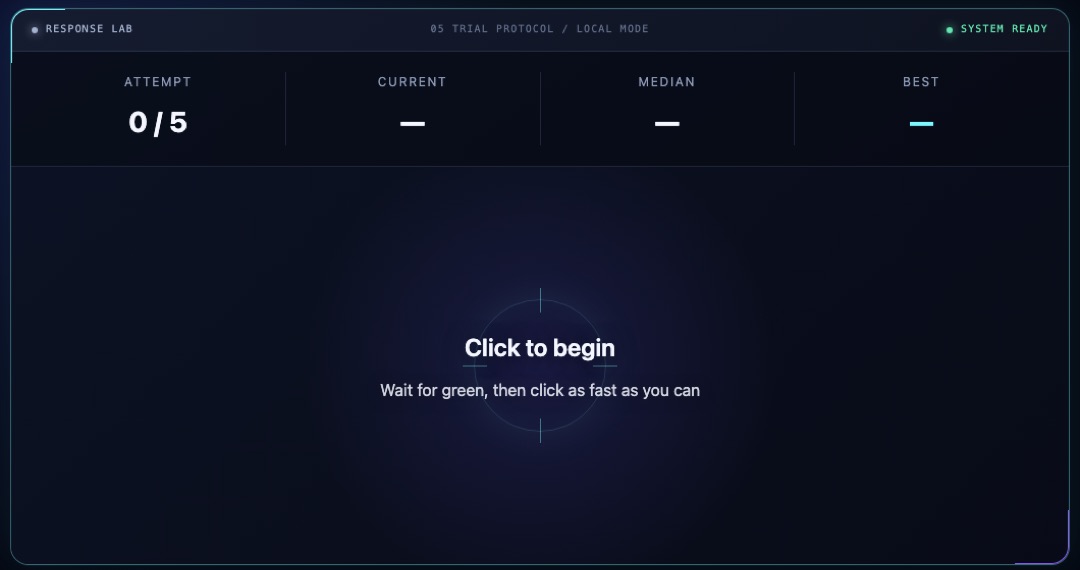
Reading about reaction time only gets you so far. The five-round test takes about a minute and gives you a median score you can actually track.
Take the reaction time testAction Video Games: Interesting, With Caveats
One of the more cited findings in this area comes from Dye, Green and Bavelier (2009): people who regularly play action video games respond faster across a range of tasks without sacrificing accuracy. Speed and accuracy usually trade off against each other, so improving both at once is notable.
Read the finding carefully, though. It shows that experienced action-game players perform differently; it does not prove that buying a game will shave a set number of milliseconds off your test score, and results vary between individuals and study designs. The reasonable interpretation is that fast-paced visual tasks demanding constant attention and rapid decisions seem to keep those skills sharp — which is consistent with the task-specificity principle above.
If you already play, consider it a complement to structured testing rather than a replacement. Games train attention under pressure; a reaction test gives you a clean, repeatable measurement of it.
Physical Activity, Breaks, and Everyday Habits
The evidence here is thinner, so we will keep the claims modest. General physical activity and good daily habits plausibly support alertness and cognitive function, but the studies in our source list do not quantify a direct effect on test scores.
What you can say with confidence is about session hygiene — the conditions around the test itself:
- Test when alert, not right after waking or late at night.
- Remove distractions: notifications, background video, and conversation all cost attention.
- Keep sessions short; long back-to-back runs produce mental fatigue, not better data.
- Take a brief break if you feel your focus slipping mid-session.
- Stay consistent with caffeine, meals, and timing so sessions are comparable.
None of this is medical advice. It is simply treating self-measurement like a small experiment, where uncontrolled variables are the enemy of a useful trend line.
Why Your Device Is Part of Your Score
Before designing a training plan, understand what your number contains. A standard 60 Hz display redraws every 16.7 ms or so, so the signal can sit on screen for up to a full frame before you ever see it. Input hardware, the operating system, and the browser each add a few more milliseconds.
The implication for training is direct: switching devices between sessions contaminates your data. A laptop median and a phone median are two different measurements wearing the same label. Pick one device, one browser, and one input method, and keep them fixed for the entire training period. The details of how our timer handles these limits are on the methodology page.
A Weekly Training Routine That Works
Here is a concrete structure built around the five-round test. Each session takes a few minutes; the discipline is in the repetition, not the volume.
- Day 1 — Baseline: run three full sessions of the five-round test, resting a minute between them, and record all three medians.
- Day 2 — Rest, or only light activity; no testing.
- Day 3 — Consistency work: two sessions, focusing on eliminating lapses rather than chasing a best round.
- Day 4 — Rest.
- Day 5 — Volume check: three sessions, tracking the spread between your best and worst medians.
- Day 6 — Variation: one session on the 10-round reaction speed test or the choice-based reflex test to keep the task fresh.
- Day 7 — Rest and review: compare the week's medians against your Day 1 baseline.
Judge progress by the trend of your medians across weeks, not by any single heroic round. A downward drift in your median, with a tightening spread, is genuine improvement on this task. For a longer-term framework with progressions, see our structured reaction training guide.
Expect the first week or two to show the largest gains — that is task learning, and it is still real progress. After that, improvement typically slows, and the value of the routine shifts to maintaining consistency and catching the days when sleep or stress shows up in your numbers.
FAQ
Can you really improve your reaction time with practice?
Yes, within limits. Practice reliably improves consistency and task-specific speed — fewer lapses, tighter spread, faster responses on the task you actually train. Claims about permanently raising your underlying physiological ceiling are much harder to support, so treat dramatic promises cautiously.
How long does it take to see improvement?
The earliest gains come from learning the task itself and often appear within the first few sessions. After that, progress usually slows and becomes about consistency rather than raw speed. Track your median over several weeks before judging whether a routine works for you; results vary.
Do action video games make your reactions faster?
Research by Dye, Green and Bavelier (2009) found that experienced action-game players respond faster without losing accuracy. That is an association, not a guaranteed prescription — but fast-paced visual games are a reasonable complement to structured testing.
Does sleep really affect reaction time that much?
The evidence is strong. Van Dongen et al. (2003) showed that cumulative sleep restriction degrades sustained attention and cognitive performance in a dose-dependent way. If you want faster and more consistent scores, protecting your sleep is the highest-leverage habit available.
Why did my score get worse after a week of training?
Short-term fluctuations are normal and usually reflect sleep, stress, distractions, or a change of device — not lost ability. Check your testing conditions first, and judge the trend over weeks of medians rather than one bad session. If you changed hardware, the comparison may simply be invalid.
Sources
- Woods et al. (2015), Frontiers in Human Neuroscience — calibrated reaction-time benchmarks across protocols.
- Web-based reaction time sample (2020), Frontiers in Aging Neuroscience — median 301 ms in 10,060 online participants.
- Van Dongen et al. (2003), Sleep — cumulative sleep restriction degrades sustained attention.
- Dye, Green & Bavelier (2009) — action-game players respond faster without accuracy loss.
- Best Reaction Test methodology — timer, five-round median, and hardware-limit notes.

Mikasa writes the timer code, reads the primary research, and checks every published claim against it — the same standard described in our editorial policy.
This article is educational, not medical or safety advice. Claims are reviewed against the linked sources and our editorial policy.
Launch the reaction time test
Five rounds, random delays, median score — run it on this device and start your own baseline today.
Start the five-round test