Test Your Reflexes Reaction Time Game
Reflex games look simple: wait for a signal, respond as fast as you can, read the milliseconds. But the family is bigger than one color-change test. Different game modes measure different things — pure detection, decision-making under time pressure, and the discipline of not jumping early — and picking the right one depends on what you actually want to train.
Overview
Reflex games look simple: wait for a signal, respond as fast as you can, read the milliseconds. But the family is bigger than one color-change test. Different game modes measure different things — pure detection, decision-making under time pressure, and the discipline of not jumping early — and picking the right one depends on what you actually want to train.
We run several of these modes on Best Reaction Test, and this guide walks through how each one works, what skill it exercises, and how to read your scores sensibly. One thing up front: every online score includes your device and browser latency, so treat any number as rough orientation rather than a lab measurement, and always compare like with like.
The Reflex Game Family at a Glance
Every reflex game shares the same skeleton: a stimulus appears, and you respond as quickly as possible. What changes between modes is the mental work that happens between those two events. That small difference in the middle turns out to matter a lot, because it decides which skill the game is actually exercising.
- Simple reaction games: one signal, one response — pure detection speed.
- Choice reaction games: several possible signals, each needing a different response — detection plus decision.
- Start-reaction games: a fixed warning sequence before the signal, with early jumps punished as false starts.
- Extended-round variants: more rounds per session, which exposes consistency and focus over time.
None of these is objectively better. They answer different questions about how you respond.
Simple Reaction Games: Pure Detection
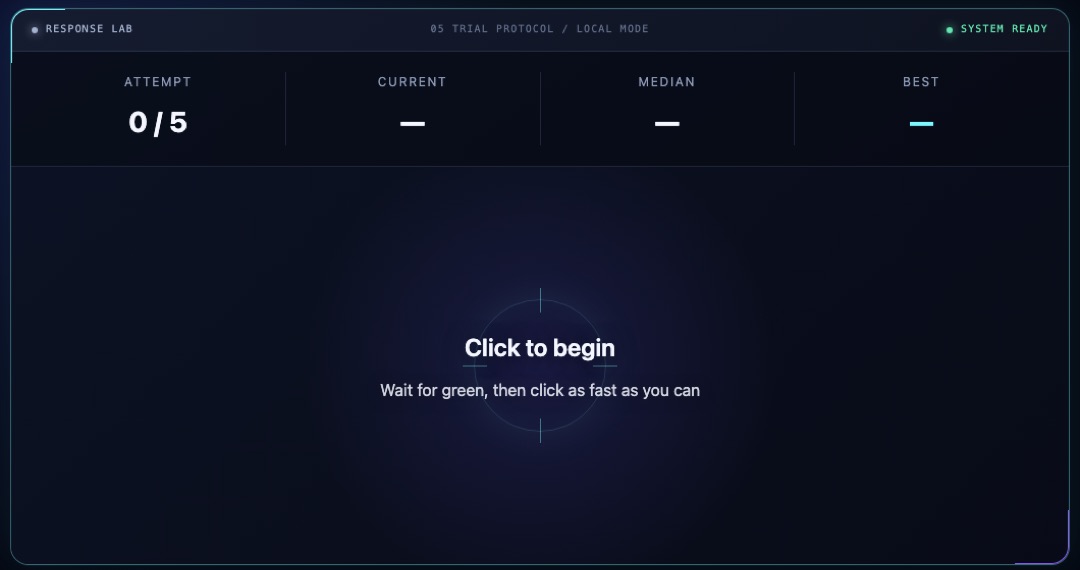
The classic version is our five-round reaction test: the screen changes color after a random delay, and you click the moment it does. Behind that single click, your retina registers the change, your visual cortex processes it, and a motor command travels to your finger. In calibrated laboratory conditions, the mean simple visual reaction time across 1,469 adults was about 231 milliseconds in a 2015 study by Woods and colleagues.
If you want a steadier benchmark, the ten-round mode trades a little brevity for stability — more rounds smooth out one lucky click. There is a trade-off, though: after a dozen back-to-back rounds, attention starts to drift, and the later rounds can sag for reasons that have nothing to do with reflexes. Running this site, we notice the same pattern constantly: a person's first round is almost always their slowest, because part of it is spent learning what the signal looks like.
What this mode trains is raw detection and consistency. There is no decision to make and no wrong answer to suppress, which makes it the cleanest baseline in the family — and the best place to start.
Skip the guesswork — measure it
Reading about reaction time only gets you so far. The five-round test takes about a minute and gives you a median score you can actually track.
Take the reaction time testChoice Reaction Games: Detection Plus Decision
Our color-choice reflex test adds one extra step: the screen can change to different colors, and only the correct response counts. Now you have to identify which signal appeared and produce the matching action, while keeping the wrong-but-tempting responses locked down. That identification step is real mental work, not a rounding error.
Expect your scores here to run noticeably higher than on a simple test, and do not read that gap as a slower reflex. You are timing a longer pipeline — detection plus classification plus response selection. A choice-mode number and a simple-mode number live on different scales, and comparing them directly tells you nothing.
This mode suits goals where the decision is the point. Most real-world situations that feel like reflexes — reading a play in sport, reacting to the right cue in a game — are actually choice problems. Practicing the decision step is closer to those demands than pure detection ever gets.
Start-Reaction Games: The F1 Lights-Out Mode
The F1 lights-out test works like a Grand Prix start: five red lights come on one by one, hold for a random interval, and you react the instant they go out. Jump early and it counts as a false start, exactly as it would on the grid. That penalty changes the whole psychology of the task.
Instead of rewarding raw speed alone, this mode trains you to hold readiness through a tense waiting period without pre-firing. The random hold is what keeps it honest — any predictable rhythm would turn reaction into memorized anticipation. Many people find it the hardest mode emotionally, even when their simple-reaction scores are strong, because the punishment for guessing is immediate.
A useful reality check applies here and everywhere else: a score under roughly 100 milliseconds on any browser test indicates anticipation, not reaction. Human visual processing simply cannot complete the loop that fast once device latency is included.
Picking the Right Mode for Your Goal
The fastest way to choose is to name the skill you care about, then match it to the mode that isolates that skill:
- Quick baseline check or first-ever test: the five-round simple mode.
- A more stable personal benchmark to track over weeks: the ten-round mode.
- Decision speed and staying accurate under pressure: the color-choice mode.
- Start-reaction discipline and resisting the urge to jump early: the F1 lights-out mode.
- Whatever you pick, keep the device constant — a score on a phone touchscreen never feels identical to a mouse score.
Rotating between modes is fine, since each one loads attention differently. Just keep your records separate per mode so the trends stay meaningful.
What Scores Mean Across Modes
If you take one idea from this guide, make it this: every protocol produces its own scale. The published numbers make the point clearly. The calibrated lab study above reported a mean of 231 ms, but a large computerized study by Vincent and colleagues, with 107,413 participants, reported 261 ms, and a different computer protocol used by Deary and Der produced 328 ms in 1,930 adults. A web-based sample of 10,060 participants — the setup closest to what you are using — found a median of 301 ms and a mean around 318 ms.
Hardware explains much of that spread. A standard 60 Hz display redraws every 16.7 milliseconds, so the signal can sit on screen for up to a full frame before you ever see it, and your mouse, touchscreen, and browser each add a little more. Your online score is biology plus setup, which is why no single universal average exists. Age moves things too, but gently: in the Woods data, observed means rose gradually from roughly 218 ms in the youngest adults to about 239 ms in the oldest.
Choice-mode scores sit higher again because decision time is added on top. None of these numbers are grades — they are reference estimates for the specific method that produced them, and individual results vary. Compare your own scores within one mode, on one device, under similar conditions, and the trends will tell you far more than any single round.
FAQ
Is a reflex game the same thing as a reaction time test?
In practice, yes — the game format is just a reaction test with instant feedback and repeatable rounds. The underlying measurement is identical: the interval between a stimulus and your response. What changes between games is the type of stimulus and response, which is why the modes above are not interchangeable.
Which reflex game mode should a beginner start with?
Start with a simple five-round test. It has the least to learn, so your scores stabilize quickly and reflect detection speed rather than task familiarity. Once your results settle into a consistent range, branch out to choice or lights-out modes depending on what you want to train.
Why is my choice-mode score so much slower than my simple-mode score?
Because you are timing a longer mental pipeline. Identifying which signal appeared and selecting the right response adds real processing time on top of basic detection. A higher number here is expected — the two scores live on different scales.
Can playing reflex games improve my real-world reactions?
Practice reliably improves performance and consistency on the specific task you practice, and it teaches useful habits like sustained focus and resisting anticipation. Claims that any game permanently rewires your baseline physiology are much harder to support, so treat dramatic promises with caution and use the games as structured practice, not magic.
Is a score under 100 milliseconds legitimate?
On a browser-based test, almost certainly not. A 60 Hz screen alone can add up to 16.7 ms of display delay before you even see the signal, and human visual processing needs far longer than the remainder. Scores that low mean the click was anticipated — started before the signal registered — rather than reacted to.
Sources
- Woods et al. (2015): Factors influencing the latency of simple reaction time — calibrated lab simple visual RT, including protocol comparisons.
- Web-based reaction time sample (2020), Frontiers in Aging Neuroscience — median 301 ms across 10,060 online participants.
- Best Reaction Test methodology — how our timer, rounds, and hardware-limit notes work.

Mikasa writes the timer code, reads the primary research, and checks every published claim against it — the same standard described in our editorial policy.
This article is educational, not medical or safety advice. Claims are reviewed against the linked sources and our editorial policy.
Launch the reaction time test
Five rounds, random delays, median score — run it on this device and start your own baseline today.
Start the five-round test