Reaction Time Test Challenge Yourself
One reaction time test tells you almost nothing. Your score swings with sleep, attention, the time of day, and pure luck on a single click, so a number you measured once says more about that moment than about you. A 30-day self-challenge fixes that: instead of chasing one flattering result, you build a small personal dataset and watch how it moves. Everything below runs on the free [five-round reaction time test](/) — no equipment, no signup, just a browser and a little discipline.
Overview
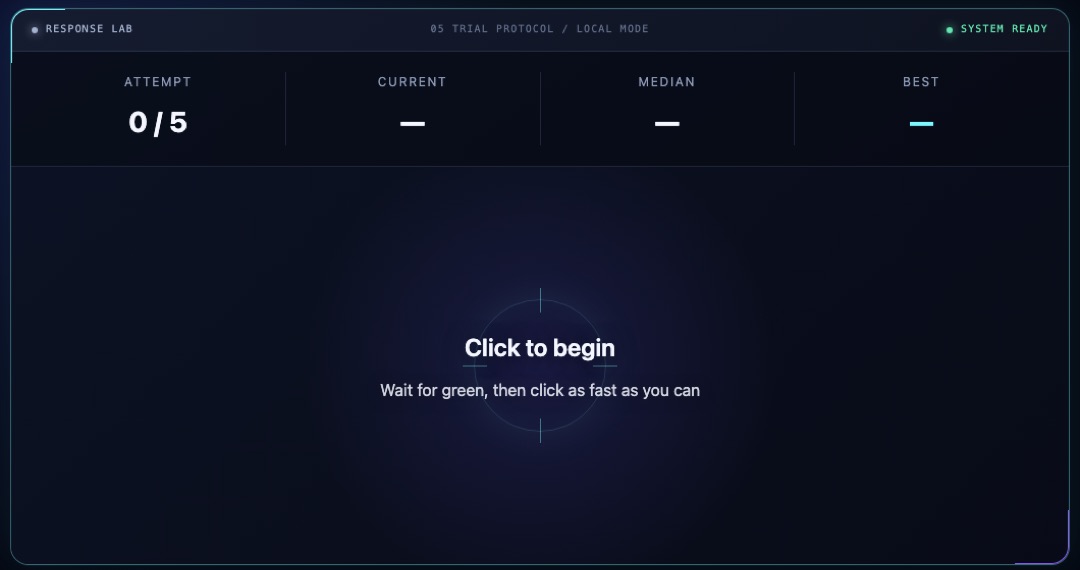
The 30-day challenge is a structured way to find out what your reaction time actually is and whether better habits move it: one five-round session per day on the free reaction time test, same device and same time of day, recording only the median. Week one establishes your baseline, weeks two through four are a training block built mostly on sleep and consistency, and week five is a controlled re-test under week-one conditions. No equipment, no signup — just a browser and a small daily habit.
The structure exists because one reaction time test tells you almost nothing. Your score swings with sleep, attention, the time of day, and pure luck on a single click, so a number you measured once says more about that moment than about you. Building a small personal dataset fixes that. Along the way you follow a short list of rules that keep your scores comparable, and you track everything in a plain template.
Why a 30-Day Challenge Beats Random Testing
Reaction time is genuinely variable, and that variability is exactly why one-off testing misleads. In a calibrated laboratory study of 1,469 adults, Woods and colleagues measured a mean simple visual reaction time of about 231 ms — while a web-based sample of 10,060 people, tested on their own devices at home, produced a median of 301 ms. Same human hardware, different context, different number. The protocol and the setup are always part of the score.
A structured month sidesteps that problem by holding the context constant. When the device, the hour, and the routine stay fixed, the remaining movement in your scores reflects you — your sleep, your focus, your practice. That is a comparison worth making, and it is the only kind an online test can honestly support.
Week 1: Establish Your Baseline
Do not try to be fast this week. Your only job is to find out what your ordinary, unforced performance looks like. Run one session per day for seven days, at roughly the same time each day, on the same device. Complete the five rounds, write down the median, and walk away.
Expect the numbers to wander. Your first round of each session is almost always the slowest — part of it is spent re-learning what the signal looks like — and some days will simply be off days. That spread is not a problem; it is the baseline. Recording it honestly is what makes week five meaningful. If you want the details of why the median and not your best round is the number to trust, our methodology page explains the reasoning.
Ground Rules for Comparable Scores
The whole challenge rests on keeping conditions stable. These rules are not optional extras — break them and you are measuring your circumstances, not your progress.
- Same device, same browser, every session. A 60 Hz screen redraws every ~16.7 ms, and touchscreens, mice, and operating systems each add their own delay, so hardware is baked into every score you record.
- Same time of day. Test late at night and you will likely see slower, sloppier rounds than a mid-morning session.
- Five rounds per session, and record the median — never just your best click.
- Quiet conditions: seated, notifications off, no video playing in the background.
- One session per day. After a dozen back-to-back rounds, attention starts to drift and the numbers stop meaning anything.
- Scores under ~100 ms mean you anticipated the signal rather than reacted to it. Note the round, but do not count it as progress.
Skip the guesswork — measure it
Reading about reaction time only gets you so far. The five-round test takes about a minute and gives you a median score you can actually track.
Take the reaction time testWeeks 2–4: The Training Block
Three weeks is enough time to change habits, not physiology. Keep your daily test session — it is now both practice and measurement — and build the rest of the block around the factors that actually show up in your scores.
Sleep comes first. Van Dongen and colleagues showed that cumulative sleep restriction degrades sustained attention and cognitive performance in a dose-dependent way — the deficit builds night after night, even when people stop noticing it. If your challenge month includes regular late nights, expect your medians to say so. Protecting your sleep schedule is the closest thing this challenge has to a training program.
Second, practice staying ready rather than reacting harder. Most of what improves with repetition is consistency: fewer distracted rounds, less wasted motion, calmer waiting. If you want variety, the choice-color reflex test adds a decision on top of the response, which trains a different skill than pure anticipation control. There is also evidence that action video game players respond faster without sacrificing accuracy (Dye, Green & Bavelier) — treat that as interesting context, not a prescription to restructure your hobbies around a browser test.
This is how serious performers in fast sports actually train. Esports professionals and table tennis players build their edge through fixed daily routines and repetition under stable conditions, not through occasional heroic sessions — and goalkeepers facing penalties rehearse the same pre-kick routine every time so their attention arrives on cue. Your daily five rounds at the same desk and the same hour is the same principle at hobby scale.
Week 5: The Re-Test
Return to the exact conditions of week one: same device, same hour, same routine, one session per day for the final week. Resist the urge to cram extra rounds before a session — you would be measuring fatigue, not improvement.
If you want a steadier final read, the 10-round reaction speed test gives the median more data to work with; just make sure you use the same mode for every re-test session. Running this site, we notice most people instinctively compare their single best round from week one against their best round from week five. Compare medians instead — the week-one median set against each day of the re-test week. That is the number that survived thirty days of practice.
What Realistic Progress Looks Like
Consistency improves first. The earliest honest sign of progress is a narrower spread inside each session — your worst round stops lagging so far behind your best. A shifting median usually comes later and more modestly, and results vary from person to person. Keep expectations proportionate: in the Woods et al. data, observed means rose only from roughly 218 ms in the youngest adults to about 239 ms in the oldest, so age itself moves reaction time by a few milliseconds across decades. A month of practice will not rewrite your nervous system, and any source promising that deserves skepticism. Our page on average reaction time gives useful reference estimates for context — rough orientation, not diagnosis.
Track the challenge in a plain note or spreadsheet, one row per session. A workable template needs only a few columns:
- Date and time of the session.
- Device used (this should never change — the column exists to catch drift).
- Session median, plus best and worst round.
- A one-line note on sleep and how you felt.
- Anything unusual: interruptions, guessed rounds, a change of room or posture.
After thirty days, those rows tell you far more than any single score could — whether your medians trend, how tightly your rounds cluster, and which days of the week you test well. That self-knowledge is the real prize of the challenge.
Common Mistakes During a 30-Day Reaction Challenge
Most failed challenges break in the same three places:
- Letting the conditions drift. A different chair, a new browser, sessions sliding from morning to midnight — each change quietly re-baselines the experiment. Treat the ground rules as part of the challenge, and note any break in your log instead of pretending it did not happen.
- Adding extra sessions when scores stall. Doubling up feels productive, but back-to-back sessions measure fatigue and corrupt comparability. One session a day, and let a plateau be data rather than a verdict.
- Comparing best rounds across weeks. A lucky tail click from week one will usually beat an honest one from week five, and you will learn nothing. Compare medians only — week one's median against each day of the re-test week.
A 5-Step Self-Check for a Challenge You Can Trust
Once a week, audit your own challenge with these five checks — each one answerable from your log:
- The device column never changes. If it did, restart your baseline rather than stitching two setups together.
- One session per day, every day you logged — no doubles, no make-up sessions.
- Every entry records the median, with best and worst round kept as context, never as the headline.
- Sleep and interruptions are noted next to any session that looked off, so slow days have an explanation on file.
- Week five uses the exact mode, device, and hour of week one — the re-test only means something if the conditions match.
FAQ
How much faster will I get in 30 days?
Expect improved consistency first and a modest median shift second, if at all. Most of what practice changes is task-specific — staying focused, waiting calmly, avoiding wasted clicks — rather than raw biological speed. Treat your final medians as personal reference points, not a grade.
What if my scores get worse during the challenge?
Look at your notes before you worry. A bad night of sleep, a stressful day, or a late-evening session explains most slow days, and one off session is noise rather than a trend. If several days in a row drift upward, check the ground rules — something in your conditions probably changed.
Can I run the challenge on my phone?
Yes, as long as you commit to it for the full month. A score on a phone touchscreen never feels identical to a mouse score, and the hardware delay differs, so switching devices mid-challenge breaks comparability. Pick whichever device you will actually have at the same time each day.
Should I use the five-round or ten-round test?
Use the five-round test for daily sessions — it is short enough that attention stays sharp. The ten-round mode is a good option for re-test week if you want a median built from more data, but keep the mode identical across every session you plan to compare.
Is this challenge a medical or athletic assessment?
No. It is a self-tracking exercise built on a browser test, and browser scores always include device and display latency. The results are rough orientation about your own consistency and habits — never a diagnosis or a measure of fitness for anything. If you have a genuine concern about your reactions or alertness, talk to a professional.
What counts as real improvement after 30 days?
The first honest sign is a tighter spread — your worst round stops lagging so far behind your best. A lower median may follow, but modestly; practice mostly improves consistency and task familiarity, not raw biological speed.
What is a typical score on this test?
On a typical home setup, a median under 250 ms is on the fast side, 250–300 ms is typical, and a persistent median above 350 ms usually reflects state or device factors. Browser scores include hardware latency, so read them as personal reference points, not rankings.
What if I miss a few days?
Missing days does not ruin the challenge — your log just has gaps. Keep going and note the break; if you miss most of a week, redo the baseline week so week five still has something fair to compare against.
Sources
- Woods et al. (2015), Frontiers in Human Neuroscience — calibrated lab means and age-related shifts in simple visual reaction time.
- Web-based reaction time sample (2020), Frontiers in Aging Neuroscience — median 301 ms across 10,060 online participants.
- Van Dongen et al. (2003), Sleep — cumulative sleep restriction degrades attention dose-dependently.
- Dye, Green & Bavelier (2009) — action game players respond faster without accuracy loss.
- Best Reaction Test methodology — how the five-round median and timer work.

Mikasa writes the timer code, reads the primary research, and checks every published claim against it — the same standard described in our editorial policy.
This article is educational, not medical or safety advice. Claims are reviewed against the linked sources and our editorial policy.
Launch the reaction time test
Five rounds, random delays, median score — run it on this device and start your own baseline today.
Start the five-round test