Test Your Reaction Time Free Online Game
Some games need a download, an account, and an hour of your evening. A reaction time game needs one click and about thirty seconds. You wait for the screen to change, you tap as fast as you can, and a number in milliseconds appears instantly. That tiny loop is the entire game — and it is surprisingly hard to play just once.
Overview
Some games need a download, an account, and an hour of your evening. A reaction time game needs one click and about thirty seconds. You wait for the screen to change, you tap as fast as you can, and a number in milliseconds appears instantly. That tiny loop is the entire game — and it is surprisingly hard to play just once.
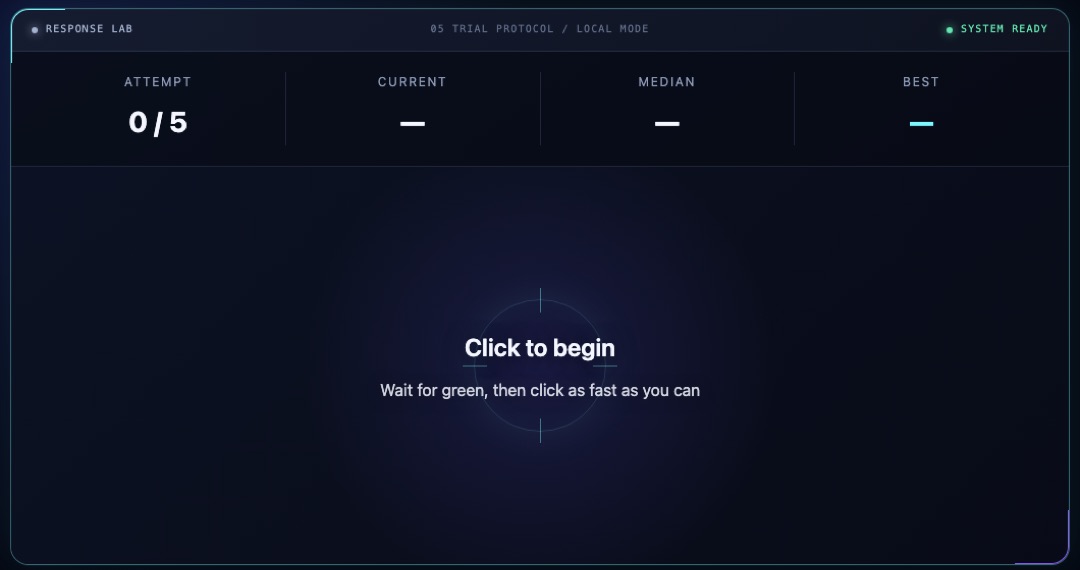
This guide looks at the free reaction time test on Best Reaction Test from the game side: why the format is so replayable, what those instant scores actually tell you, and how to move from casual clicking to intentional practice when you want to improve.
Why Reaction Tests Work So Well as Micro-Games
Game designers talk about the core loop — the smallest repeatable unit of play. In most games the loop takes minutes: finish a level, win a hand, complete a match. In a reaction test the loop is a few seconds long. Wait for the signal, respond, see your time. The feedback is instant, numeric, and brutally honest, which is exactly what makes a micro-game compelling.
There is also no friction around the loop. Nothing installs, nothing asks for your email, and a full session of five rounds fits inside a coffee break. Running this site, we notice that many visitors finish their five rounds and immediately start another session — the classic “one more try” pattern you see in arcade games, compressed into its purest form.
What Your Score Actually Measures
Behind that single click sits a real chain of events: your retina detects the color change, your visual cortex processes it, your brain issues a motor command, and your finger carries it out. Reaction time is the measurable sum of that chain.
In calibrated laboratory conditions, a 2015 study by Woods and colleagues reported a mean simple visual reaction time of about 231 milliseconds across 1,469 adults. Other protocols land in different places. A large computerized study by Vincent and colleagues, with 107,413 participants, reported 261 ms, while a different computer protocol used by Deary and Der produced 328 ms in 1,930 adults. A web-based sample of 10,060 people — the setup closest to an online game like this one — reported a median of 301 ms.
The spread matters more than any single figure. Every protocol produces its own scale, and a browser game always adds your hardware to the result: a 60 Hz screen redraws only every 16.7 milliseconds, and the mouse, touchscreen, and browser each contribute a little more. Treat your score as rough orientation about you on your device, not as a lab measurement — and be skeptical of any score under about 100 ms, which almost always means the click landed before the signal rather than after it.
Skip the guesswork — measure it
Reading about reaction time only gets you so far. The five-round test takes about a minute and gives you a median score you can actually track.
Take the reaction time testThe Design Tricks That Keep You Clicking
A reaction test earns its replayability with a handful of small design decisions, most of which you never consciously notice:
- The random delay before the signal blocks prediction, so every round is a genuine attempt rather than a memorized rhythm.
- Feedback is instant and numeric — a millisecond score works like a leaderboard of one, always inviting a comparison with your last try.
- Natural variation guarantees that your next round might be your best round, which is the engine behind “one more try.”
- Sessions are short enough that there is no cost to starting one: five rounds take well under a minute.
- There is no setup at all — no download, no signup, no saved profile to manage.
None of this is accidental — endless runners and one-tap arcade games use the same ingredients: a fast loop, a visible score, a near-zero price for replaying. The difference is that the score you chase here happens to be a real measurement.
Casual Play Is Enough to Learn Your Baseline
Here is the useful part of the game format: because rounds are cheap and quick, you will actually repeat them — and repetition is what turns a novelty number into a baseline. One round tells you almost nothing. A dozen sessions scattered across different days start to cluster, and that cluster is a fair picture of your typical speed.
A few patterns show up for almost everyone. Your first round of a session is usually the slowest, because part of it is spent re-learning the task before your attention settles. Most people find that after a dozen or more back-to-back rounds, focus starts to drift and the times creep upward. Test late at night and you will likely see slower numbers — consistent with research showing that cumulative sleep restriction degrades sustained attention and cognitive performance in a dose-dependent way.
Age shifts the baseline too, but gently. In the Woods et al. data, observed mean reaction time rose gradually from roughly 218 ms in the youngest adult group to about 239 ms in the oldest — a slow drift across decades, not a cliff. Whatever your cluster looks like, treat it as a reference estimate for tracking yourself, not a diagnosis of anything.
From Playing to Practicing
Casual play answers the question “how fast am I?” Practice asks a different one: “can I get faster?” The shift is mostly about intention. Instead of chasing a single lucky best, you test on the same device at a similar time of day, you watch your typical range rather than your highlight reel, and you stop a session when attention fades instead of grinding through tired rounds.
There is reasonable evidence that speed of response is trainable in context. Dye, Green and Bavelier (2009) found that action video game players respond faster than non-players without sacrificing accuracy — practice with fast decisions appears to sharpen fast decisions. What the evidence does not support are dramatic promises of a permanently rewired baseline, so keep expectations modest: practice improves consistency and task-specific performance, and results vary from person to person. If you want structure, our reaction training guide lays out a more deliberate approach.
Other Ways to Play
Once the basic five-round game feels familiar, a few variations keep it interesting while measuring slightly different skills. The ten-round reaction speed test doubles the session length, which smooths out lucky and unlucky rounds and gives you a steadier median to compare over time.
The choice reflex test shows one of several colors and asks you to respond only to the right one, adding a decision on top of raw speed — a different game with a noticeably different feel. The F1 lights-out test copies the start of a Grand Prix: five lights, a random hold, then lights out. It punishes anticipation hard, which makes it a fun way to test your discipline as well as your speed.
Switching modes keeps casual play fresh, but compare scores within a mode — a choice-task score and a simple-task score measure different things.
FAQ
Is a reaction time test a game or a real measurement?
It is both, and that is the point. The game format — instant rounds, instant scores, free replay — is what makes you repeat the measurement often enough for it to mean something. The number itself is a genuine timing of a genuine response, just one that includes your device and conditions.
Why is my first round always my slowest?
Part of the first round is spent learning the task again: what the signal looks like, how the timing feels, where your finger rests. After a round or two you settle in, and the later rounds better reflect your actual response speed. This is normal and shows up for almost everyone.
How many rounds should I play in one sitting?
One or two sessions of five rounds is plenty. Most people find that after a dozen or more back-to-back rounds, attention starts to drift and scores inflate — at that point you are measuring fatigue, not reflexes.
Can playing games actually make me faster?
In context, yes — research on action video game players shows faster responses with no loss of accuracy, so practiced speed on fast tasks is a real thing. Broader claims about permanently changing your underlying physiology are much harder to support, so treat big promises with caution.
Is a score under 100 ms possible?
On a browser test, essentially no. A 60 Hz display alone can add up to about 16.7 ms before the signal is even visible, and human biology adds far more than the remainder. A sub-100 ms result almost always means you clicked before the signal appeared — anticipation, not reaction.
Sources
- Woods et al. (2015), Frontiers in Human Neuroscience — calibrated lab mean of 231 ms; Table 1 comparison figures.
- Web-based reaction time sample (2020), Frontiers in Aging Neuroscience — median 301 ms across 10,060 online participants.
- Van Dongen et al. (2003), Sleep — sleep restriction degrades sustained attention dose-dependently.
- Dye, Green & Bavelier (2009) — action game players respond faster without accuracy loss.

Mikasa writes the timer code, reads the primary research, and checks every published claim against it — the same standard described in our editorial policy.
This article is educational, not medical or safety advice. Claims are reviewed against the linked sources and our editorial policy.
Launch the reaction time test
Five rounds, random delays, median score — run it on this device and start your own baseline today.
Start the five-round test