Reaction Time Test Track Your Progress
A single reaction time score tells you almost nothing. Take the test twice and the numbers differ; take it twenty times and you get a cloud of results with no obvious meaning. The value of an online reaction time test only appears when you track your results over weeks, under consistent conditions, and learn to read the trend instead of the noise.
Overview
To track your reaction time progress, log the median of a full five-round session — not your best round — two to four times a week, always on the same device at a similar time of day, with a quick note on sleep and conditions. Then review weekly instead of daily: treat a change as real only when it persists across two or more weekly reviews under the same setup, because day-to-day swings are normal physiology, not progress or decline. Single scores tell you almost nothing; the trend of your medians tells you nearly everything an online test honestly can.
This guide covers the practical side of progress tracking: what to write down after each session, how to review your numbers weekly without overreacting to one slow day, and how the local history on this site keeps your data on your own device. None of this is medical or diagnostic — it is a simple habit for anyone curious about how their reflexes change over time.
What to Record After Each Session
Most people record one number and forget the context that produced it. That makes their history nearly useless, because a 270 ms median after a full night's sleep and a 270 ms median at 1 a.m. are very different results. A useful log entry takes under a minute and captures four things: the result, the spread, the conditions, and the time.
The result should be your session median, not your best round. One lucky click — or one early click that slipped past the anticipation check — says little about your reflexes. The median of a full session is a far steadier summary, and our methodology page explains why we built the test around it.
- Session median — your headline number for the day.
- Spread — the gap between your fastest and slowest round, which reveals consistency.
- Conditions — device, input method, sleep quality, caffeine, distractions.
- Time of day — morning and evening scores are not interchangeable.
- Round count — how many rounds the median is based on.
That spread item deserves emphasis. Two sessions can share the same median while one is tightly clustered and the other swings wildly between rounds. A narrowing spread is often the first real sign of improvement, well before the median itself drops.
Your Local History on This Site
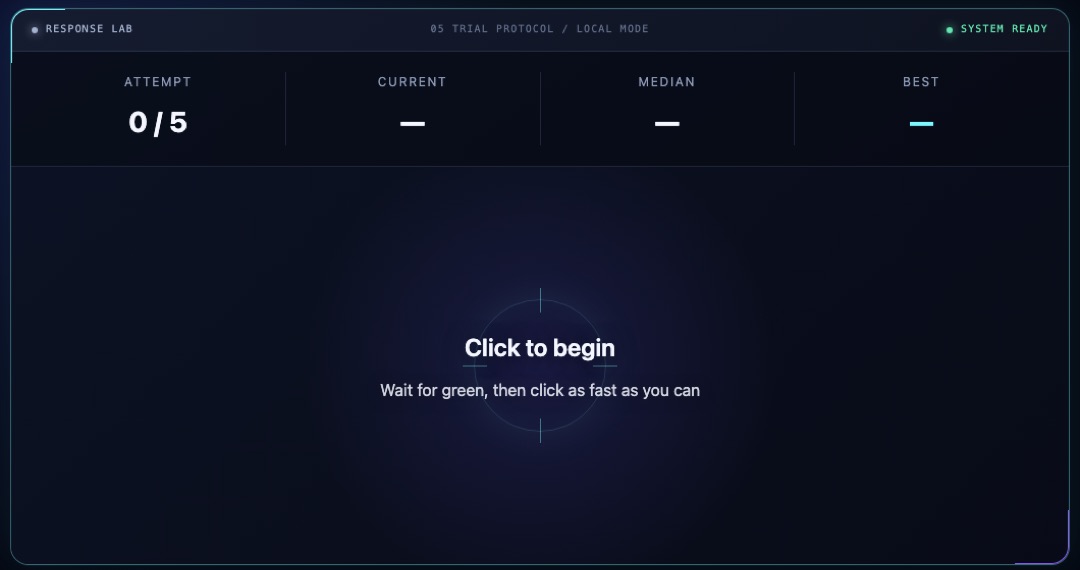
The five-round test on Best Reaction Test keeps a history of your recent sessions in your browser's local storage. There is no account, no sign-up, and no server-side log — the record lives on your device and nowhere else. Clearing your browser data clears the history with it.
Running this site, we notice people underestimate how valuable this is. Local storage means you can build a genuine personal baseline without handing your results to anyone, which matters more for a reflex score than it might seem — a slow day says something about you, and that observation should stay yours. Our privacy page spells out exactly what is and is not stored.
The trade-off is that local history is tied to one browser on one device. Switch machines or browsers and you start fresh — which, as the next sections explain, is actually a feature: scores are only comparable within a fixed setup anyway.
Build a Weekly Review Habit
Checking your numbers after every session invites overreaction. A weekly review is the right cadence: frequent enough to catch real changes, slow enough that daily noise averages out. Pick one evening, look at the week's medians together, and ask three questions.
- Is the middle of this week's medians drifting up, down, or sideways?
- Is the spread within each session getting tighter or wider?
- Do the conditions column explain any outlier sessions?
Resist the urge to draw conclusions from fewer than two or three weeks of data. Test late at night and you'll likely see your median climb; sleep in on a weekend and it may fall. These swings are normal physiology, not progress or decline, and only a longer window separates them from a genuine trend.
Keep the sessions themselves modest. A few five-round sessions per week is plenty. After a dozen back-to-back rounds, attention starts to drift and later rounds get slower — you end up logging fatigue, not reflexes.
This is how people who depend on split-second responses already work. Esports players reviewing aim-trainer scores and F1 teams logging practice starts both look at patterns across many attempts under recorded conditions — nobody judges a driver by one launch. Your weekly median review is the same habit at a smaller scale.
Skip the guesswork — measure it
Reading about reaction time only gets you so far. The five-round test takes about a minute and gives you a median score you can actually track.
Take the reaction time testReading Trends vs Noise
The hardest skill in tracking is deciding what deserves a response. Day-to-day variation is large, and several forces create it. Your state is one: Van Dongen and colleagues (2003) showed that cumulative sleep restriction degrades sustained attention and cognitive performance in a dose-dependent way, so a run of short nights will show up in your log before you consciously feel tired.
Your hardware is another. A 60 Hz screen redraws every 16.7 milliseconds, so the signal can sit on screen for part of a frame before you ever see it — and that is before mouse, touchscreen, and browser delays are added. A score on a phone touchscreen never feels identical to a mouse score, because it is not: same biology, different measurement chain. Any trend that coincides with a new device is hardware noise until proven otherwise.
Also keep perspective on how much movement is even possible. Across published studies, protocol differences alone shift the average from 231 ms in a calibrated lab sample of 1,469 adults to a median of 301 ms in a web-based sample of 10,060 people. If whole measurement systems differ by tens of milliseconds, a 15 ms wobble between your Monday and Wednesday sessions is well within the noise band.
A practical rule of thumb: treat a change as real only when it persists across two or more weekly reviews, under the same device and roughly the same time of day. Anything faster than that is probably weather, not climate.
When to Adjust Your Training
Tracking without action is just bookkeeping. Once a trend is confirmed — not guessed — you have a few sensible moves. If your median has plateaued but your spread is tightening, you are getting more consistent; that is real progress and usually a sign to vary the challenge rather than grind more of the same.
Variety helps because different modes stress different skills. The 10-round speed test gives you a larger sample per session, the choice-color reflex test adds a decision on top of raw speed, and the F1 lights-out test punishes anticipation the way a real race start does. Rotating between them keeps practice honest and makes it harder to game one specific timing.
If your trend is drifting slower week over week, look at conditions before looking at training. Poor sleep, late-night sessions, and distraction account for most slow patches. Structure beats intensity here — our reaction training guide covers the evidence, including why action video game players respond faster without losing accuracy in controlled tasks, and why sleep is the foundation everything else sits on.
Common Mistakes When Tracking Your Progress
- Recording only your best round. A highlight number flatters you and quietly wrecks the trend, because one lucky click says little about your typical speed. Log the session median — and ideally the spread — every time.
- Reacting to a single slow day. Sleep, caffeine, and time of day can swing your score far more than any training effect, so one bad session means nothing on its own. Wait for a change that persists across two or more weekly reviews before adjusting anything.
- Changing devices mid-track. A new phone, monitor, or mouse changes the measurement chain itself, so old and new scores are not comparable. If your setup changes, treat it as day one of a new baseline rather than a sudden decline.
A 5-Step Self-Check for Your Tracking Habit
- Open your log and confirm each entry has four things: session median, spread between fastest and slowest round, conditions, and time of day. If any column is missing, add it from the next session onward.
- Verify that every session you are comparing came from the same device and browser.
- Count your sessions — two to four per week is plenty, and if you are grinding long daily sessions you are mostly logging fatigue.
- Run your weekly review: is the middle of this week’s medians drifting up, down, or sideways, and is the spread within each session tightening?
- Before changing any habit, check that the shift you noticed survived at least two weekly reviews under the same setup.
FAQ
How often should I test my reaction time?
Two to four sessions per week is a good rhythm for most people. Daily testing is fine if sessions stay short, but more frequent testing adds data without adding insight — and long sessions measure fatigue more than reflexes.
How long before I see real improvement?
Expect the first few sessions to improve simply because you are learning the task — your first round of a session is almost always the slowest, and early sessions are full of first rounds. Genuine trend-level change, if it comes, shows up over weeks, not days. Judge it by the direction of your weekly medians, never by a single personal best.
Why do my scores vary so much from day to day?
Sleep, attention, time of day, and caffeine all move your score, and device latency adds another layer of variation on top. This is exactly why the conditions column in your log matters: most "bad days" have a mundane explanation written right next to them.
Should I throw out my worst rounds before comparing sessions?
No. Deleting slow rounds flatters your numbers and destroys the trend you are trying to measure. The median already resists outliers — that is the point of using it — so let it do its job and keep every round in the record.
What does a score under 100 ms mean?
On a browser test, a sub-100 ms result means you clicked before your brain could have processed the signal — anticipation, not reaction. Given display and input latency, genuine responses are simply not that fast online. Treat those rounds as false starts and ignore them.
What is a good reaction time to aim for?
For a browser-based test, under roughly 250 ms is fast and 250–300 ms is a very typical range for healthy adults, while scores over 350 ms usually reflect state or device factors worth retesting. The more useful target is personal: a median that holds steady or tightens over weeks on your own setup beats any universal benchmark.
Does an online reaction test measure my true reflexes?
No, and it is worth being upfront about the limitation: an online score is your biology plus display, input, and browser latency, and what it times is a voluntary response rather than a spinal reflex anyway. It cannot match lab-grade equipment — but keep the device and conditions constant, and the trend in your medians becomes a genuinely useful signal.
Why did my scores get worse after I switched laptops?
Because the measurement chain changed, not necessarily because you did. Screen refresh rate, input hardware, and browser behavior all feed into the final number, so scores from two devices are different measurements. Start a fresh baseline on the new setup rather than comparing across the switch.
Is my reaction time data private on this site?
Yes. Your session history lives in your browser’s local storage on your own device — there is no account, no sign-up, and no server-side log. Clearing your browser data clears the history with it, and switching browsers or devices starts a fresh record.
Sources
- Woods et al. (2015), Frontiers in Human Neuroscience — calibrated lab visual RT, mean ≈ 231 ms, N=1,469.
- Web-based sample (2020), Frontiers in Aging Neuroscience — online median 301 ms, N=10,060.
- Van Dongen et al. (2003), Sleep — sleep restriction degrades attention dose-dependently.
- Dye, Green & Bavelier (2009) — action game players respond faster without accuracy loss.
- Wilkinson & Allison (1989) — gradual age-decade RT differences, N=5,325.

Mikasa writes the timer code, reads the primary research, and checks every published claim against it — the same standard described in our editorial policy.
This article is educational, not medical or safety advice. Claims are reviewed against the linked sources and our editorial policy.
Launch the reaction time test
Five rounds, random delays, median score — run it on this device and start your own baseline today.
Start the five-round test