Free Online Reaction Test No Signup
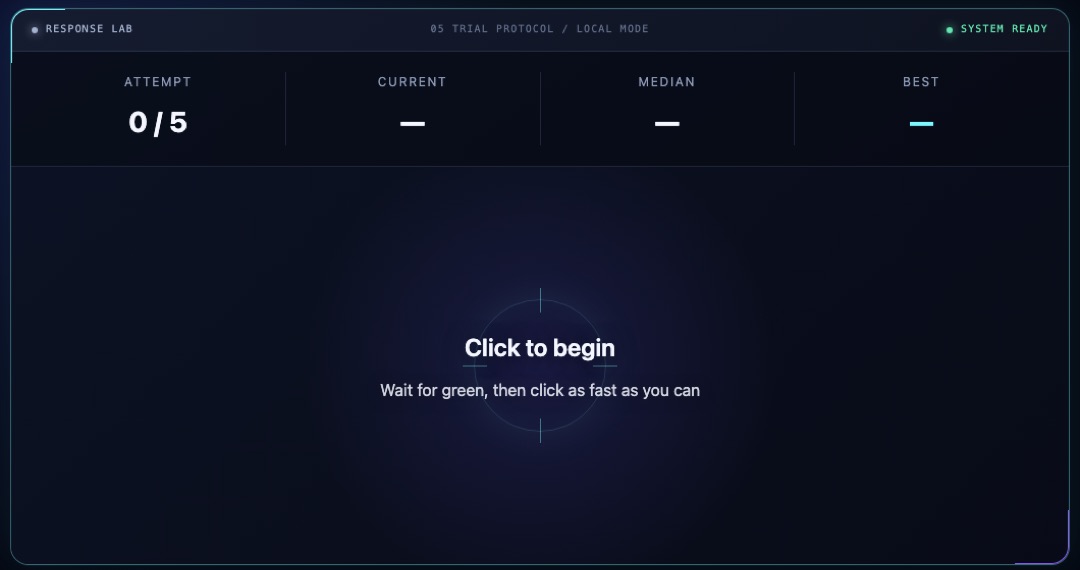
You want to check your reflexes right now, not after creating an account, confirming an email, and accepting a newsletter you never asked for. The [free reaction time test](/) on this site works the way a tool like this should: open the page, click through five rounds, read your median in milliseconds. No signup, no login, no profile.
Overview
You want to check your reflexes right now, not after creating an account, confirming an email, and accepting a newsletter you never asked for. The free reaction time test on this site works the way a tool like this should: open the page, click through five rounds, read your median in milliseconds. No signup, no login, no profile.
That is a deliberate design choice, and it is mostly about privacy. Every result you produce here stays in your own browser. There is no account to attach your scores to and no server quietly logging them. This article explains how that local mode actually works, why it is better for honest personal measurement, and how to run a fair test once you are in.
Why No-Signup Testing Matters
Signup walls solve the site's problem, not yours. An account lets a service track you across sessions and devices, build a profile, and email you later. None of that makes your reaction time measurement more accurate — it just makes your data more valuable to someone else.
Friction has a measurement cost too. Reaction time is sensitive to attention and mood, and a two-minute registration detour is enough to change the state you were in when you got curious. A test you can start in seconds captures you as you actually are, which is the only version of you worth measuring.
There is also a practical benefit for repeat testing. The right way to use an online test is to compare your own results over time on the same device — and a tool that lives entirely in your browser is ideal for exactly that, with no syncing surprises and no forgotten passwords standing between you and a quick session.
How Local Mode Actually Works
Local mode means the entire test — the timer, the random delay, the median calculation, and your session history — runs inside your browser on your device. Your score is computed locally and never transmitted to our servers. Running this site, we built it this way on purpose: data that never reaches us cannot be leaked, sold, or breached.
The mechanism behind your saved history is localStorage, a small storage area every modern browser provides to websites. When you finish a session, the result is written to that store on your device. On your next visit, the page reads it back so you can see your recent medians. The data never leaves the machine unless you move it yourself.
A few consequences follow from that design, and they are worth understanding:
- Your history lives on one device and one browser — your laptop will not show scores you recorded on your phone.
- Clearing your browser's site data erases your history, because there is no server-side backup to restore it from.
- Private or incognito windows usually discard localStorage when you close them, so use a regular window if you want sessions saved.
- No one else can look up your results — there is no leaderboard, no public profile, and no account to breach.
If you want the fine print on what is and is not collected, our privacy policy spells it out. The short version: your scores are yours.
Skip the guesswork — measure it
Reading about reaction time only gets you so far. The five-round test takes about a minute and gives you a median score you can actually track.
Take the reaction time testWhy Privacy Makes for More Honest Baselines
This is the part people rarely think about: measurement works better when nobody is watching. When scores are public or tied to an identity, behavior shifts. People test until they get a number they like, screenshot their best round, and quietly discard the rest. The data becomes performance instead of measurement.
A private, local test removes that pressure. There is nothing to win, so there is no reason to cherry-pick. You can run five rounds, accept a mediocre median on a tired afternoon, and still log it — which is exactly the kind of honest data point that makes a long-term baseline meaningful.
Reaction time genuinely fluctuates with your state. In the classic sleep-restriction study by Van Dongen and colleagues (2003), cumulative sleep loss degraded sustained attention and cognitive performance dose-dependently — the more sleep people lost, the worse they performed. If your score history includes the sleepy evenings alongside the sharp mornings, the trend line tells you something real. If it only contains your highlight reel, it tells you nothing.
How To Test Yourself Fairly
A no-signup test is only as useful as the conditions you run it under. The protocol matters more than the tool, so treat each session like a small experiment:
- Use the same device and browser every time — hardware differences shift scores more than most people expect.
- Sit in a quiet room with notifications off; a single distraction costs real milliseconds.
- Complete all five rounds and read the median, not just your best click.
- Test at a similar time of day so fatigue and daily rhythm do not confuse the comparison.
- Let your first session be practice — early rounds are partly spent learning the task itself.
- Retest over days and weeks; the trend of your medians beats any single result.
The five-round median exists to absorb the noise. One lucky or unlucky click says almost nothing about your reflexes, but the middle value of five honest attempts is a stable reference point. The full reasoning — how the timer works, why the median, and where hardware limits bite — is on the methodology page.
What Your Score Does and Doesn't Tell You
Context first: in calibrated laboratory conditions, a 2015 study by Woods and colleagues measured simple visual reaction time in 1,469 adults and found a mean of about 231 milliseconds. Observed means rose gradually with age, from roughly 218 ms in the youngest adult group to about 239 ms in the oldest — a slow drift, not a cliff.
Browser-based numbers sit higher, and that is expected. A web-based sample of 10,060 participants reported a median of 301 ms — a setup much closer to the test you are about to take. Part of the gap is engineering, not biology: a 60 Hz screen redraws only every ~16.7 ms, and the mouse, operating system, and browser each add their own delay before your click is registered.
So your online score is your biology plus your device. Treat it as a personal reference estimate, not a diagnosis and not a number to compare against lab figures or a stranger's screenshot. The comparisons that mean something are yours: same device, same conditions, over time. Age shifts the baseline gently — Wilkinson and Allison (1989) documented decade-by-decade differences across 5,325 participants — so judge yourself against your own recent history, not against universal rankings. Our average reaction time page lays out the study data in more detail.
FAQ
Do I really not need an account?
Correct. Open the page and test immediately. There is no registration form anywhere in the process, and no email is ever requested.
Where are my results stored?
In your browser's localStorage, on your own device. Your scores are computed locally and never sent to a server, which is why clearing your browser data also clears your history.
Can someone else see my scores?
No. There is no account, no leaderboard, and no server-side database of results. The only copy of your history is in the browser you tested on.
Why does my history disappear on my other device?
Because localStorage is tied to one browser on one device, by design. There is no cloud sync — that is the privacy trade working as intended. Pick one primary device for long-term tracking.
Is a no-signup test less accurate than a lab test?
It measures the same underlying response, but your score includes device and browser latency, so it runs higher than calibrated lab figures. Use it for personal tracking and rough orientation, not clinical conclusions.
Sources
- Woods et al. (2015), Frontiers in Human Neuroscience — calibrated lab simple visual reaction time, 1,469 adults.
- Web-based reaction time sample (2020), Frontiers in Aging Neuroscience — median 301 ms across 10,060 online participants.
- Wilkinson and Allison (1989) — age-decade reaction time differences in 5,325 participants.
- Van Dongen et al. (2003), Sleep — cumulative sleep restriction degrades sustained attention.
- Best Reaction Test privacy policy — what local mode stores and never transmits.
- Best Reaction Test methodology — timer, five-round median, and hardware limits.

Mikasa writes the timer code, reads the primary research, and checks every published claim against it — the same standard described in our editorial policy.
This article is educational, not medical or safety advice. Claims are reviewed against the linked sources and our editorial policy.
Launch the reaction time test
Five rounds, random delays, median score — run it on this device and start your own baseline today.
Start the five-round test