Reaction Test Game Improve Your Skills
A reaction test game looks almost too simple to practice: wait for the color change, click, read your milliseconds. Yet people who treat it as a skill — with a warm-up, a plan, and a way to handle plateaus — reliably end up with tighter, faster results than those who just click whenever they remember to. The difference is rarely raw talent. It is structure.
Overview
A reaction test game looks almost too simple to practice: wait for the color change, click, read your milliseconds. Yet people who treat it as a skill — with a warm-up, a plan, and a way to handle plateaus — reliably end up with tighter, faster results than those who just click whenever they remember to. The difference is rarely raw talent. It is structure.
This guide lays out that structure: a short warm-up, a sensible session format, a four-week progression mixing our five-round test with longer and harder modes, and a playbook for when scores stop moving. One caveat up front: every browser score includes device latency, so the only honest comparison is you against your own past results on the same setup.
Why Reaction Time Responds to Practice
Reaction time feels like a fixed trait, but the measured number is a bundle of skills: sustaining attention, detecting the signal quickly, and executing one clean motor response. Each can be sharpened. In the calibrated laboratory data compiled by Woods and colleagues, the mean simple visual reaction time across 1,469 adults was about 231 ms — yet the spread between individuals was wide, much of it down to attention and familiarity rather than wiring.
Speed is also trainable at the attention level. Dye, Green and Bavelier found that habitual action video game players respond faster than non-players without sacrificing accuracy — they process the signal more efficiently, not just click sooner. The lesson transfers: repeated, focused exposure to a respond-fast task moves the needle.
Running this site, we notice the same pattern in session after session: the first round is almost always the slowest. The brain needs a trial or two to lock onto the task. That single observation explains most of what a good warm-up is for.
A Two-Minute Warm-Up Routine
Warming up is not about stretching your fingers; it is about removing noise — from your environment and your head — so the rounds that count reflect your current ability. Keep it short and repeat it identically every session:
- Close extra tabs, silence notifications, and kill any background video or music.
- Settle into the same posture and the same device position you use every time.
- Run two or three throwaway rounds you deliberately ignore, just to calibrate your eyes and finger to the signal.
- Fix your gaze on the center of the test area and watch the color, not your own hand.
- Take one slow breath before each real round starts — tension costs milliseconds.
Those throwaway rounds address the slow-first-round effect: by the time your scored session begins, the novelty is gone and attention is in the right mode.
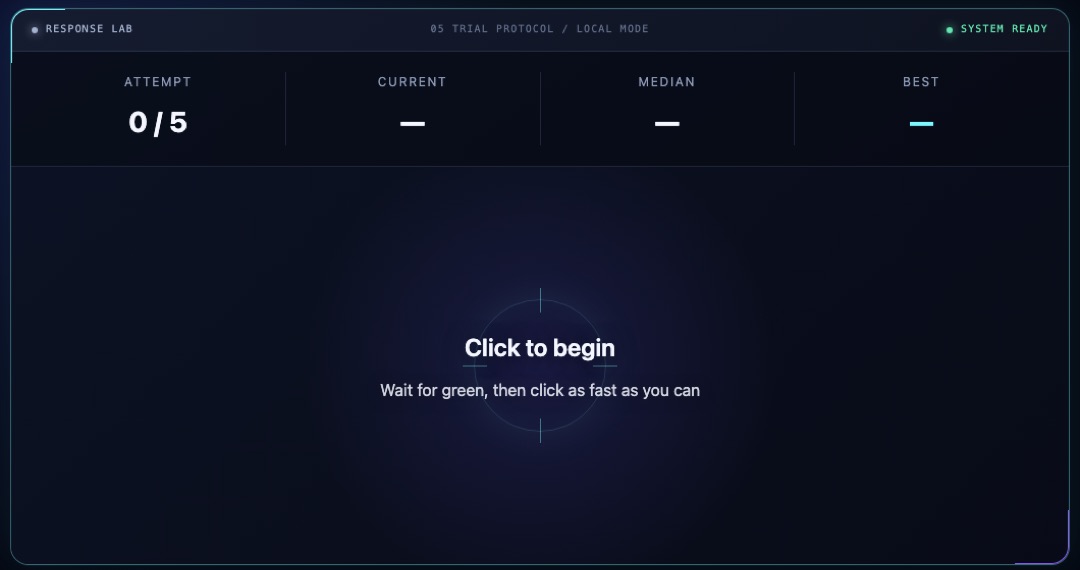
Skip the guesswork — measure it
Reading about reaction time only gets you so far. The five-round test takes about a minute and gives you a median score you can actually track.
Take the reaction time testStructure Each Session
A productive session is short and bounded. One scored block on the main reaction time test is five rounds reported as a median, so one lucky — or terrible — click cannot dominate the result. For a steadier read, step up to the ten-round reaction speed test: the extra rounds smooth out noise at the cost of a little more fatigue.
A few rules keep sessions honest:
- Record the median, never your single best round — the best round is often half anticipation.
- Cap practice at two or three scored blocks per sitting, with a real break between them.
- Stop when attention slips; after a dozen back-to-back rounds, focus drifts and the numbers stop meaning anything.
- Test at roughly the same time of day so daily rhythm does not masquerade as progress or decline.
If a round comes back under roughly 100 ms, treat it as a guess, not a reflex. A 60 Hz screen redraws every 16.7 ms, and display plus input latency is baked into every online score — genuine responses do not land that low in a browser. Scores that fast mean you predicted the signal — a habit you will have to untrain later.
A Four-Week Progression
Progress comes in phases, and each phase calls for a different emphasis. This plan assumes three to five practice days per week, one or two short sessions per day — small doses, done consistently:
- Week 1 — Baseline. Run the five-round test once or twice a day at a fixed time, changing nothing else. You are establishing your starting median, not chasing improvement yet.
- Week 2 — Volume. Move your main session to the ten-round mode. The extra repetitions build consistency, and your median becomes a more trustworthy number to track.
- Week 3 — Discrimination. Add a block of the choice-color reflex test, where you react to the right color rather than any signal. Choice reactions are harder and sharpen the detection stage that simple reactions leave lazy.
- Week 4 — Anticipation control. Finish with sessions on the F1 lights-out test, which punishes jumping early exactly the way a race start does. Then retest your five-round baseline and compare medians.
Rotating modes keeps practice from going stale. Pure repetition teaches your brain to expect one task; switching formats forces the underlying skill — see signal, decide, move — to stay flexible.
Breaking a Plateau
Every practitioner hits a stretch where the median stops improving. Before assuming you have reached your ceiling, work through the usual suspects. The most common is sleep: Van Dongen and colleagues showed that cumulative sleep restriction degrades sustained attention and cognitive performance dose-dependently — even when you feel fine. Test late at night after a short week of sleep and you will likely see your medians sag.
The second suspect is anticipation. As you get comfortable, timing the signal instead of reacting to it becomes tempting, and scores oscillate between suspiciously fast guesses and slow recoveries. The fix is a few days on a mode with a harsher random delay, like the lights-out test, which makes guessing visibly expensive.
The last lever is deliberate rest. Attention-heavy practice accumulates a quiet fatigue that two or three days off clears, and most people come back from a short break with steadier medians. If nothing moves the number after a few weeks, accept the plateau as your current level under current conditions — results vary, and a browser median is rough orientation, not a verdict on your nervous system.
What Progress Actually Looks Like
Set expectations against reference points, not fantasies. A web-based sample of 10,060 people — the closest published analogue to what you are doing here — reported a median of 301 ms, while other protocols have produced means of 261 ms and 328 ms depending on hardware and task design. There is no single average human reaction time, so there is no single target to beat.
Age moves the baseline gently: in the Woods et al. data, observed means rose from roughly 218 ms in the youngest adults to about 239 ms in the oldest, and Wilkinson and Allison found a similar decade-by-decade drift across 5,325 participants. Realistic progress looks like a tighter median, less-bad worst rounds, and a modest visible slide in your whole distribution over a month. Track your own trend on the same device and let that be enough.
FAQ
How long does it take to see improvement?
Most people see scores stabilize within the first week — that early gain is mostly task familiarity. More meaningful shifts in your median typically take two to four weeks of consistent short sessions. Test sporadically and the noise drowns out any trend.
Can I practice reaction tests every day?
Yes, as long as sessions stay short. A block or two per day is plenty; grinding dozens of rounds mostly trains you to perform while distracted. And keep your sleep intact — accumulated sleep debt erodes exactly the sustained attention this task depends on.
Is a fast touchscreen score the same as a fast mouse score?
No. A phone touchscreen score never feels identical to a mouse score, and the numbers are not comparable — touch input, display refresh, and mobile browsers each add latency. Pick one device for tracked sessions and treat the other as a separate game.
Do video games actually make you faster?
The Dye, Green and Bavelier study found action game players respond faster without losing accuracy — real evidence that speeded-attention skills transfer. It is still an association, not a prescription; targeted practice on the test itself is the more direct route.
Why did my scores suddenly get worse?
Sudden drops are almost always state, not skill: poor sleep, fatigue, illness, alcohol, or plain distraction. Retest on a rested day before reading anything into a bad session — one rough day describes that day, not your reflexes.
Sources
- Woods et al. (2015), Frontiers in Human Neuroscience — calibrated lab means, age gradient, and protocol comparisons.
- Web-based sample (2020), Frontiers in Aging Neuroscience — online median and mean for 10,060 participants.
- Wilkinson & Allison (1989) — decade-by-decade age differences in 5,325 people.
- Van Dongen et al. (2003), Sleep — dose-dependent cost of sleep restriction to attention.
- Dye, Green & Bavelier (2009) — action gamers respond faster without accuracy loss.

Mikasa writes the timer code, reads the primary research, and checks every published claim against it — the same standard described in our editorial policy.
This article is educational, not medical or safety advice. Claims are reviewed against the linked sources and our editorial policy.
Launch the reaction time test
Five rounds, random delays, median score — run it on this device and start your own baseline today.
Start the five-round test