Reaction Test Challenge How Fast Are You
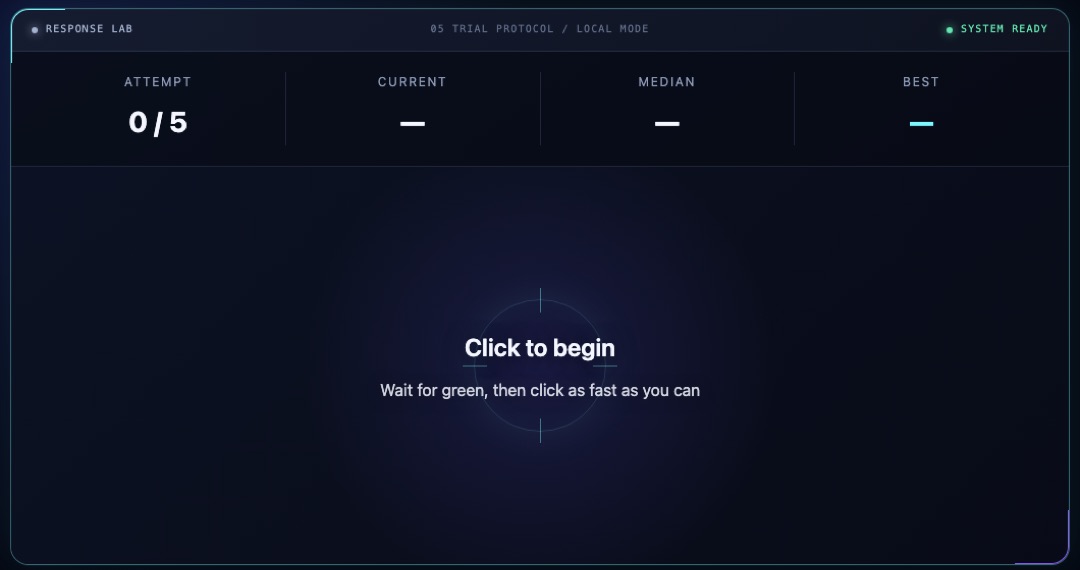
Here is a challenge that takes less time than making coffee. Open the [reaction test](/), wait for the screen to change, click as fast as you can, and in about a minute you will have a number most people never measure: your visual reaction time in milliseconds. No signup, no setup, just you against a color change.
Overview
Here is a challenge that takes less time than making coffee. Open the reaction test, wait for the screen to change, click as fast as you can, and in about a minute you will have a number most people never measure: your visual reaction time in milliseconds. No signup, no setup, just you against a color change.
This article walks through what actually happens on a first visit — what those first five rounds tend to look like, how to read the median you land on, and the part that makes it a challenge rather than a one-off curiosity: coming back later and beating your own score under the same conditions.
Your First Minute on the Test
The flow is deliberately simple. You click once to arm a round, the screen shows a waiting state, and after a random delay it changes color. Your job is to click the instant you see the change. The timer then reports the gap in milliseconds and you move to the next round.
That random delay matters more than it seems. Because you cannot know when the color will flip, you cannot time your click in advance — each round forces a genuine response instead of a guess. If you do jump early, the round is flagged rather than counted, which keeps the final number honest.
After five rounds, the test reports the median: the middle value of your five attempts. One lucky click or one distracted moment gets ignored, so the number you walk away with reflects your typical performance rather than your best or worst. The full reasoning behind this design is on our methodology page.
What Your First Five Rounds Usually Look Like
Running this site, we notice a remarkably consistent first-visit pattern, and it is worth knowing before you judge yourself. Your first round is almost always the slowest — not because your reflexes are bad, but because part of that round is spent learning the task itself. You are figuring out what the signal looks like, how the timing feels, and how much tension to hold in your clicking finger.
A typical first session unfolds something like this:
- Round 1: noticeably slow, often the worst of the session — pure unfamiliarity.
- Rounds 2 and 3: a clear drop as the task stops being new and your attention locks in.
- Round 4: usually close to your true level, sometimes your best round.
- Round 5: either a final improvement or a small fade as early focus starts to loosen.
Most people find their scores settle into a narrow band by the third or fourth round. That settling point is the interesting part of the challenge — it is roughly where your nervous system performs when it knows what it is doing. The median of five rounds captures exactly that, filtering out both the clumsy opener and any fluky fast click.
Skip the guesswork — measure it
Reading about reaction time only gets you so far. The five-round test takes about a minute and gives you a median score you can actually track.
Take the reaction time testHow to Read Your First Median
The first question everyone asks is whether their number is any good. The honest answer is that there is no single universal benchmark, because every testing setup produces its own scale. In calibrated laboratory conditions, a 2015 study by Woods and colleagues measured a mean simple visual reaction time of about 231 ms across 1,469 adults. A web-based sample of 10,060 participants — much closer to the setup you are using — reported a median of 301 ms.
The gap between those two figures is mostly hardware, not biology. A standard 60 Hz screen redraws every ~16.7 ms, and your mouse, touchscreen, and browser each add a little more. Your online score is always your biology plus your device, so treat any first median as rough orientation, not diagnosis. Our average reaction time page explores these reference numbers in more depth.
One more reading tip: if a round comes back under ~100 ms, that was anticipation, not reaction. Nobody's visual system beats the signal chain that fast — you guessed, and the random delay happened to cooperate. Rounds like that are exactly what the median is there to absorb.
Why the First Score Is a Starting Line, Not a Verdict
Plenty of first-time visitors see a mediocre median and assume they have slow reflexes. Usually they have simply measured themselves on a bad day, on an unfamiliar task, or both. Attention, alertness, and comfort with the test all move the number, and none of them are fixed traits.
Sleep is the clearest example. Van Dongen and colleagues (2003) showed that cumulative sleep restriction degrades sustained attention and cognitive performance dose-dependently — the worse the sleep debt, the worse the performance. Test late at night after a short week of sleep and you will likely see it in your median. Even practice effects show up in research: Dye, Green and Bavelier (2009) found that action video game players respond faster without sacrificing accuracy, evidence that speeded responding is partly trainable.
So treat the first median as your baseline — the number to beat — rather than a judgment. That reframe is what turns a thirty-second distraction into an actual challenge.
The Challenge: Come Back and Beat It
Here is the challenge proper. Write down your first median, the device you used, and roughly when you tested. Then come back another day — rested, same device, same browser, similar time of day — and run the test again. The question is not whether you can hit one lucky fast click; it is whether your median moves.
A few ground rules keep the rematch fair:
- Same device and input method every session — a phone touchscreen and a mouse are not comparable.
- Similar conditions: quiet room, no notifications, no video running in the background.
- Rested beats exhausted — retesting after a better night's sleep is a legitimate strategy, not cheating.
- Judge the median across a full session, never a single round.
- Give it days, not minutes — fatigue from back-to-back sessions muddies the comparison.
Once five rounds feels too short to be decisive, step up to the 10-round reaction speed test for a more stable median. And if you want to challenge a different skill entirely, the choice-color reflex test adds a decision on top of raw speed, while the F1 lights-out test recreates the five-light start that punishes even a blink of anticipation. For structured work on the underlying skill, our reaction training guide covers what practice can and cannot change.
FAQ
How fast is the average person on a reaction test?
It depends entirely on the setup. Calibrated lab research reports a mean near 231 ms for simple visual reaction time, while a large web-based sample — the closest match to an online test like this one — reported a median of 301 ms. Browser scores always include device latency, so the two are not directly comparable.
Why was my first round so much slower than the rest?
Because round one doubles as a learning round. You are discovering what the signal looks like and calibrating how ready to be, and that costs milliseconds. By round three or four most people settle into a narrower, faster range — which is why the median of five rounds is a fairer measure than any single attempt.
Is a score under 100 ms possible?
Not as a genuine visual reaction on a browser test. A 60 Hz display alone adds up to ~16.7 ms of delay, and input hardware adds more on top of your biology. A reading under ~100 ms means you clicked in anticipation and the random delay cooperated — the test flags early clicks for exactly this reason.
How often should I retest myself?
Spacing sessions out by days works better than hammering rounds back to back. Attention drifts within a long session, and fatigue inflates your median. A short session every few days, under similar conditions, gives you a trend you can actually trust.
Can I genuinely get faster, or is my baseline fixed?
Consistency and task-specific speed respond well to practice, and research on action game players suggests speeded responding is trainable to a degree. Claims about permanently rebuilding your baseline physiology are harder to support, so expect modest, real improvements rather than dramatic transformation. Results vary.
Sources
- Woods et al. (2015), Frontiers in Human Neuroscience — calibrated lab simple visual RT, mean ≈ 231 ms, N=1,469.
- Web-based reaction time sample (2020), Frontiers in Aging Neuroscience — online median 301 ms, N=10,060.
- Van Dongen et al. (2003), Sleep — sleep restriction degrades attention dose-dependently.
- Dye, Green & Bavelier (2009) — action game players respond faster without accuracy loss.
- Best Reaction Test methodology — five-round median, random delay, hardware limits.

Mikasa writes the timer code, reads the primary research, and checks every published claim against it — the same standard described in our editorial policy.
This article is educational, not medical or safety advice. Claims are reviewed against the linked sources and our editorial policy.
Launch the reaction time test
Five rounds, random delays, median score — run it on this device and start your own baseline today.
Start the five-round test