Reaction Speed Test Online Competition
A reaction speed test gets noticeably more interesting the moment someone else's score is on the line. Solo testing tells you where you stand; competition gives you a reason to come back and a built-in excuse to argue about whose laptop is slower. A browser-based test is genuinely well suited to competition — as long as the format respects what an online score does and does not measure.
Overview
A reaction speed test gets noticeably more interesting the moment someone else's score is on the line. Solo testing tells you where you stand; competition gives you a reason to come back and a built-in excuse to argue about whose laptop is slower. A browser-based test is genuinely well suited to competition — as long as the format respects what an online score does and does not measure.
That last part matters more than most people expect. A browser score is your biology plus your hardware and your state of mind that day. A 60 Hz screen redraws every 16.7 milliseconds or so, and mouse, touchscreen, and operating system each add their own delay. A format that ignores this ends up crowning the person with the best monitor rather than the fastest reflexes. The formats below hold up.
What Makes an Online Reaction Competition Work
Every workable format shares three properties. It controls the device variable, it uses enough rounds that one lucky click cannot decide the outcome, and it has an explicit rule for anticipation — clicking before the signal — because temptation rises the moment pride is involved.
A useful reality check on scale: in calibrated laboratory conditions, simple visual reaction time averages around 231 ms across large adult samples, while a web-based sample of 10,060 people — the setup closest to casual online testing — reported a median of 301 ms. A browser competition lives in that second world: winning margins of 20 or 30 milliseconds are meaningful there, arguments over 3 milliseconds are not.
Synchronous Duels
The simplest format that works: two people, two screens, one countdown. Both players start a round at the same moment — a spoken count, a chat message, or a shared video call — and compare results immediately. Best of five rounds, median decides the duel.
Duels work because the shared start removes scheduling friction and the round count keeps luck in check. Where they go wrong is hardware. If one player is on a gaming monitor and the other on a phone over hotel Wi-Fi, you are mostly measuring equipment — a score on a phone touchscreen never feels identical to a mouse score, and the numbers back that feeling up. For remote duels, agree on a device class beforehand, or accept the result as entertainment rather than measurement.
For a duel with more theater, the F1 lights-out mode is built for exactly this: five lights, a random hold, then launch. It punishes jump-starts the way real race starts do, which makes it a natural tiebreaker.
Skip the guesswork — measure it
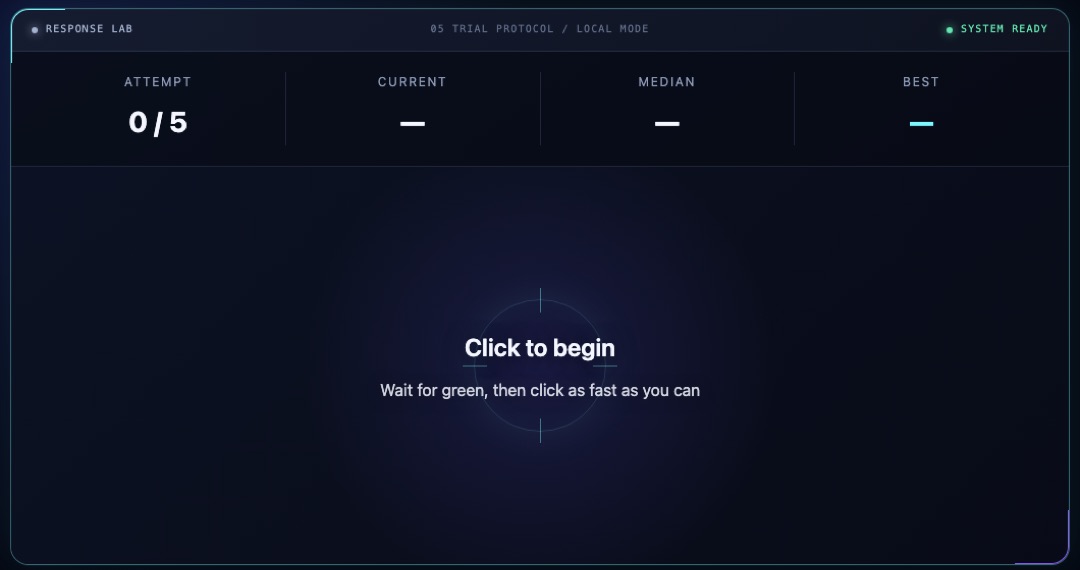
Reading about reaction time only gets you so far. The five-round test takes about a minute and gives you a median score you can actually track.
Take the reaction time testWeekly Median Challenges
The most practical format for a group chat, an office, or a Discord server is asynchronous: everyone completes the same challenge on their own time during the week and posts their median. Because each player submits a median of several rounds rather than one best click, the leaderboard resists both luck and selective reporting.
A structure that has worked well in practice:
- A fixed challenge for the week — for example, the standard five-round test, or the ten-round mode for a tighter result.
- One submission per person, posted as a screenshot or honest report.
- Same device across weeks for each player, so trends mean something.
- A season of four to six weeks, scored on consistency (best average rank) rather than one winning week.
- Anticipation clicks — anything under roughly 100 ms — void the round, no exceptions.
Running this site, we notice that the weekly rhythm itself is half the appeal. People who would never grind fifty rounds in one sitting happily do five careful rounds every Monday, and their medians tighten within weeks. Attention is the limiting factor anyway — after a dozen back-to-back rounds, focus drifts and the scores drift with it.
Same-Device Tournaments
The fairest format of all requires no trust and no equipment matching: everyone plays on the same machine. One laptop, one mouse, one chair, players rotating through brackets. Ideal for parties, classrooms, and team events, it quietly solves every latency argument because the hardware variable is identical for every competitor.
Keep brackets small and rounds short. Five rounds per match on the main test, median advances. For variety across a longer event, mix in a different mode per round — a choice-reaction round on the color mode rewards something different from simple reaction, so the same person does not win every bracket on raw speed. Give each player one warm-up round before their first match; first rounds are almost always the slowest, and a cold start is an unfair handicap.
Rules That Keep It Fair
Whatever format you choose, a short written rule sheet prevents nearly every dispute. The essentials:
- Declare the device and input method before the competition, not after a surprising result.
- Medians decide outcomes; a single best round is a highlight, not a result.
- Sub-100 ms scores are anticipation, not reaction — the signal had not even rendered meaningfully before the click.
- Standardize conditions loosely: no testing at 2 a.m. against someone who just woke up, since sleep loss measurably degrades sustained attention.
- Match similar age groups in anything you call serious — reaction time shifts gradually across adult decades, so mixed-age finals need a handicap or separate brackets.
- One warm-up round minimum before scored rounds begin.
The sleep point deserves a sentence of its own. Van Dongen and colleagues showed that cumulative sleep restriction dose-dependently degrades sustained attention — exactly what a reaction test leans on. A match between a rested player and someone on their fourth short night is partly a sleep contest. On age, Wilkinson and Allison documented gradual decade-by-decade differences across 5,325 participants: real, but small steps, so handicaps matter mainly at the extremes.
Why Esports Numbers Are the Wrong Benchmark
Sooner or later, every online competition attracts the claim that professional gamers react in some impossibly small number of milliseconds, making casual scores embarrassing. The research does not support the comparison. Dye, Green, and Bavelier (2009) found that action video game players do respond faster than non-players — crucially, without sacrificing accuracy. They are genuinely quicker on the tasks they train on.
But that finding describes task-specific speed built through enormous practice on particular stimulus patterns, not a universal advantage that transfers to a color-change click on a random Tuesday. It also says nothing about what a casual player should expect on a browser test, where device latency alone adds tens of milliseconds. Benchmark your group against its own distribution and against large web samples — the ~301 ms median above — not against a trained specialist's best task.
The healthier takeaway is that speed on a practiced task is trainable, and consistency is the visible sign of improvement. If your weekly median tightens and your spread narrows over a season, you are getting better by the only definition that matters here. Our notes on typical score ranges give reference estimates for where casual groups tend to land.
FAQ
Can people on different devices compete fairly?
Not directly. Display refresh rate, input hardware, and connection overhead are all baked into an online score, so a phone result and a desktop result are different measurements. Match device classes, rotate everyone through one machine, or treat cross-device results as fun rather than verdicts.
What is a good score to aim for in a casual competition?
Against a web-based reference median around 301 ms, anything consistently in the 250–300 ms band is a solid browser result, and sustained sub-250 ms medians are genuinely quick online. Treat these as rough orientation, not diagnosis — your trend against your own baseline is the more meaningful number.
How many rounds should a competition use?
Five is the practical minimum for a stable median; ten rounds gives a tighter estimate at the cost of late-session attention drift. Whatever you choose, fix the number in the rules so nobody shops for a lucky round count.
Is clicking early ever a legitimate strategy?
No — it is anticipation, and the data pattern gives it away. Genuine visual responses on a browser test essentially never land under about 100 ms, because the signal itself takes time to reach the screen. Most formats simply void any early-click round, which keeps the incentive pointed at real reactions.
Do experienced gamers have an unfair advantage?
A modest, real one: action game players respond faster without losing accuracy in controlled studies. But the advantage is task-specific, and hardware differences usually swamp it on an unfamiliar browser task. If your group includes both, separate brackets for a season keeps things honest.
Sources
- Woods et al. (2015), Frontiers in Human Neuroscience — calibrated lab simple visual RT, mean ≈ 231 ms, N=1,469; review table covering larger computerized protocols.
- Web-based sample (2020), Frontiers in Aging Neuroscience — median 301 ms across 10,060 online participants.
- Van Dongen et al. (2003), Sleep — cumulative sleep restriction degrades attention dose-dependently.
- Wilkinson and Allison (1989) — gradual age-decade reaction time differences, N=5,325.
- Dye, Green & Bavelier (2009) — action game players respond faster without sacrificing accuracy.

Mikasa writes the timer code, reads the primary research, and checks every published claim against it — the same standard described in our editorial policy.
This article is educational, not medical or safety advice. Claims are reviewed against the linked sources and our editorial policy.
Launch the reaction time test
Five rounds, random delays, median score — run it on this device and start your own baseline today.
Start the five-round test