Reaction Test Improve Your Focus
Most people treat a reaction test as a pure speed contest: see the color change, click, blame your reflexes if the number looks slow. But when a round goes wrong, the culprit is usually not raw speed. It is attention. Your eyes were on the screen but your mind was elsewhere — and by the time you noticed the signal, the moment had passed.
Overview
Most people treat a reaction test as a pure speed contest: see the color change, click, blame your reflexes if the number looks slow. But when a round goes wrong, the culprit is usually not raw speed. It is attention. Your eyes were on the screen but your mind was elsewhere — and by the time you noticed the signal, the moment had passed.
That distinction matters because attention is something you can control, while raw neuromuscular speed barely budges. This guide explains why focus lapses cause most slow rounds, how to audit the distractions around you, what sleep does to sustained attention, and how to use a simple reaction time test as training for concentration itself.
Run a Distraction Audit Before You Test
You cannot willpower your way past a distracting environment. Attention is largely set by what surrounds you before the round starts, so a sixty-second audit beats any amount of effort during the test. Before your next session, check these:
- Silence notifications completely — one banner mid-wait pulls your eyes for a moment you never get back.
- Close extra tabs and windows, especially anything with motion, autoplay video, or chat.
- Kill background audio with lyrics or speech; your brain cannot fully ignore language it understands.
- Put the phone face down in another room — a visible phone is a standing invitation to split attention.
- Settle your body: hand resting near the mouse, eyes relaxed on the waiting area rather than darting around it.
- Take two slow breaths before pressing start. Arriving calm beats arriving hyped.
None of this is exotic. It is the same logic exam supervisors and marksmen use: remove every competing demand so the one signal that matters gets your full processing capacity.
Skip the guesswork — measure it
Reading about reaction time only gets you so far. The five-round test takes about a minute and gives you a median score you can actually track.
Take the reaction time testSleep Is the Biggest Focus Lever
If one factor quietly dominates your scores, it is how you slept. In a landmark 2003 study by Van Dongen and colleagues, restricting sleep night after night degraded sustained attention and cognitive performance in a dose-dependent way — the less sleep, the worse the decline, and it accumulated across days rather than resetting.
The uncomfortable part is that people adapt to feeling tired without their performance adapting. You can feel roughly fine on six hours of sleep while your attentional stability sags. A reaction test exposes this: test late at night after a short week of sleep and you will likely see a noisier session with occasional far-slower rounds.
The takeaway is not to chase perfect sleep before testing — that just adds pressure. It is to read your scores in context. A slow median after a bad night describes your state, not your reflexes, and a reason to retest when rested rather than conclude anything permanent.
A Pre-Test Routine for Locking In
Athletes in timing-critical sports do not rely on being focused people in general; they rely on short, repeatable routines that switch attention on. You can borrow the idea. The goal is a thirty-to-sixty-second ritual that tells your brain: for the next few seconds, nothing exists except the signal.
- Same device, same chair, same conditions — familiarity removes the attentional cost of adjusting to novelty.
- One deliberate exhale before each round to discharge the urge to jump early.
- Eyes soft on the screen, not staring hard — a tense, fixed gaze tires faster and blinks more.
- Expect the wait, not the signal; readiness for an unknown delay is the skill being trained.
- If you false-start, pause for a breath instead of rushing to redeem yourself.
Keep the routine short enough that you will actually do it every time. Consistency of ritual, not intensity of effort, is what stabilizes attention.
Using the Test Itself as Focus Training
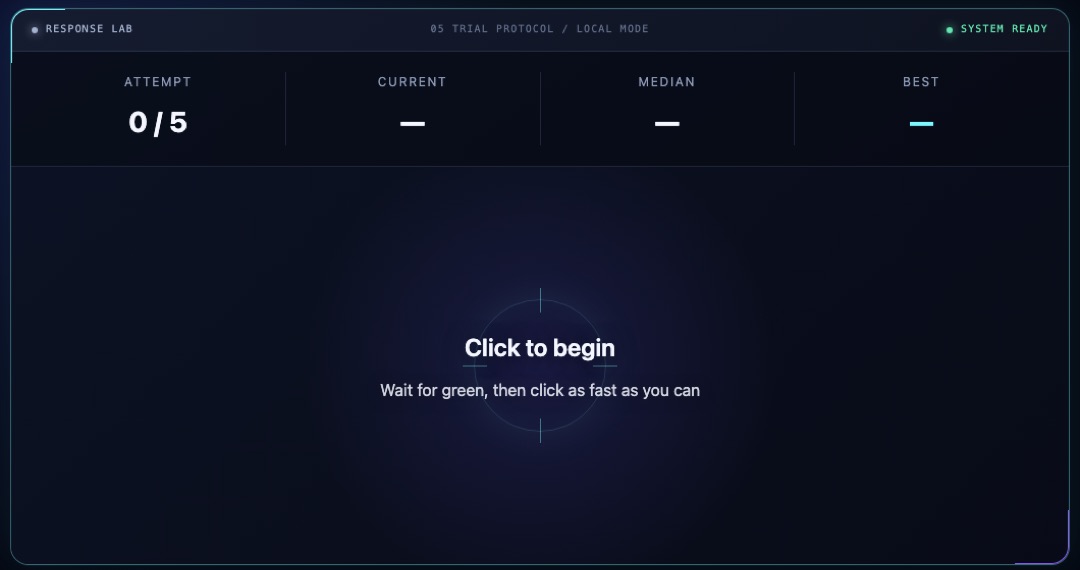
Here is the pleasant twist: the test doubles as the training. Each round is a small exercise in holding attention on a blank screen and releasing it at exactly the right instant — not too early, not late. Practiced regularly, that is a concentration workout disguised as a game.
Variety helps because each mode loads attention differently. The standard five-round test trains basic sustained readiness. The ten-round reaction speed test extends that hold, where focus fatigue shows. The choice-color reflex test keeps you attentive through a decision, not just a detection. And the F1 lights-out test punishes anticipation — pure impulse control under pressure.
A note on expectations: practiced responders can get genuinely faster. A 2009 study by Dye, Green and Bavelier found that action video game players responded faster without sacrificing accuracy — speed and care were not a trade-off. Still, treat improvement as gradual and personal, and stop each session while your attention is still good.
What Your Score Can and Cannot Tell You
Browser scores always include your hardware. A 60 Hz screen redraws only every 16.7 milliseconds, and mouse, touchscreen, and browser each add delay, so your online number is biology plus setup. That is also why scores under roughly 100 ms on a browser test indicate anticipation, not reaction — you clicked ahead of the signal, a focus failure of the opposite kind.
For context, a web-based sample of 10,060 people reported a median of 301 ms — close to what typical home setups produce. Treat every online number as rough orientation, not diagnosis, and compare only like with like. The real signal is whether your median tightens and your slow outlier rounds grow rarer as your routine improves.
FAQ
Can a reaction test actually improve my focus?
It trains one specific slice of focus: sustaining readiness for an unpredictable signal and responding without jumping early. That skill is real and practicable, and many people find it carries over into a broader sense of attentional control. It is not a treatment for attention difficulties, though — think exercise, not medicine.
Why are my scores so inconsistent within one session?
Within-session spread is mostly attention, not physiology. Your nervous system does not speed up and slow down over thirty seconds, but your mental readiness does. A tightening spread across rounds is usually the first sign your routine is working.
Does testing when tired tell me anything useful?
Yes — it tells you about your state, exactly what sleep research like the Van Dongen study would predict. Just do not read a tired session as your true level. Note the conditions, retest when rested, and compare like with like.
Is clicking early a focus problem too?
Absolutely. Anticipation is attention pointed at the wrong thing — you respond to your own prediction instead of the signal. On a browser test, anything under roughly 100 ms is almost certainly an early click, because display and input latency alone eat more time than that.
How often should I test to train focus?
Short and regular beats long and rare. One or two sessions of five to ten rounds, a few times a week, keeps attention as the challenge. Once rounds blur together and scores drift upward, stop — that drift is focus fatigue, and pushing through it trains nothing.
Sources
- Woods et al. (2015), Frontiers in Human Neuroscience — calibrated lab simple visual RT, mean ~231 ms in 1,469 adults.
- Web-based reaction time sample (2020), Frontiers in Aging Neuroscience — median 301 ms across 10,060 online participants.
- Van Dongen et al. (2003), Sleep — cumulative sleep restriction degrades sustained attention dose-dependently.
- Dye, Green & Bavelier (2009) — action game players respond faster without losing accuracy.
- Best Reaction Test methodology — how our five-round median and hardware-limit notes work.

Mikasa writes the timer code, reads the primary research, and checks every published claim against it — the same standard described in our editorial policy.
This article is educational, not medical or safety advice. Claims are reviewed against the linked sources and our editorial policy.
Launch the reaction time test
Five rounds, random delays, median score — run it on this device and start your own baseline today.
Start the five-round test